Storyblok's pricing page shows you a plan cost. What it does not show you, until you are already building, is that the number is per space, and a space is roughly one project. Run two products and you are looking at two subscriptions. Run five and the math stops being a rounding error. Add the jump from the Growth plan to Growth Plus, which roughly triples the price with nothing in between, and you can see why "Storyblok raising prices" is a recurring thread in developer forums. This is an honest breakdown of what Storyblok actually costs, tier by tier, and what the per-space model means once you run more than one blog.
Quick takeaways
- Storyblok prices per space, and a space is effectively one project or site. Multiple products usually means multiple subscriptions.
- The paid tiers are roughly Growth at $99/mo and Growth Plus at $349/mo, with a free Starter plan and custom Enterprise tiers above.
- The gap from Growth to Growth Plus roughly triples your bill with no middle option, which surprises teams that outgrow Growth.
- The free Starter plan is genuinely usable for one small project, but caps seats and features.
- If your cost pain is running many blogs, a flat per-account model removes the per-space wall entirely.
Storyblok plans and pricing tiers, plainly
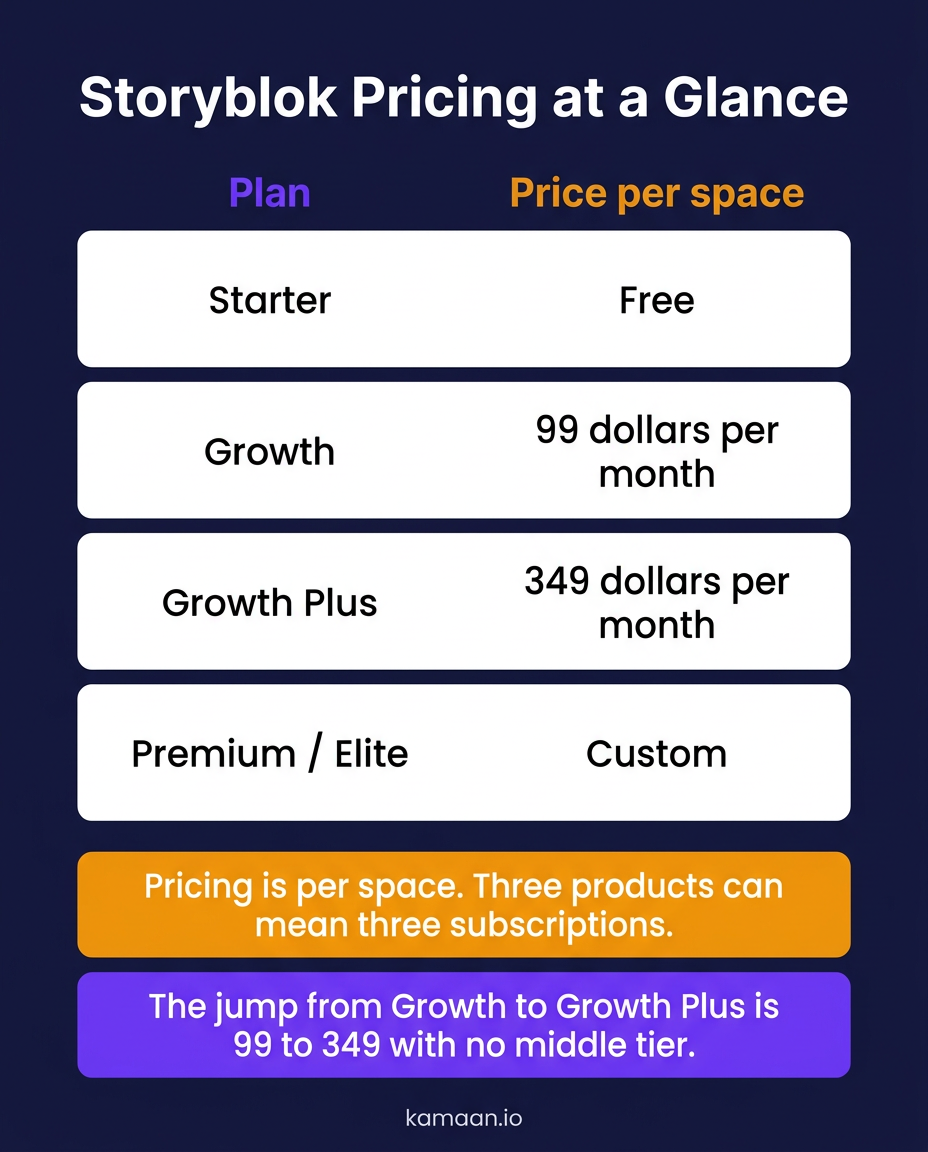
Storyblok structures its plans on a per-space basis, with a free entry point and custom-priced enterprise tiers at the top. Verify the current figures on Storyblok's own pricing page before you commit, because headless CMS pricing changes often, but as of this writing the lineup looks like this:
| Plan | Price (per space) | Roughly who it fits |
|---|---|---|
| Starter | Free | One small project, solo dev, testing |
| Growth | ~$99/mo | One growing site that needs collaboration |
| Growth Plus | ~$349/mo | A site needing scheduling and higher SLAs |
| Premium / Elite | Custom | Enterprise, multiple teams, advanced security |
The Starter plan is free forever for a limited setup and is genuinely functional: visual editor, asset manager, and core API access, capped on seats. Growth is the entry paid tier for a business that needs real collaboration. Growth Plus adds scheduling, a higher uptime SLA, and more seats. Premium and Elite are the enterprise tiers with SSO, advanced roles, and custom pricing you get by contacting sales.
What "per space" actually costs you
Here is the part the pricing table does not spell out. In Storyblok, a space is a content repository, effectively one website or project. The plan price attaches to the space, not to your account. So the real question is not "what does Growth cost," it is "how many spaces do I need, and what does each one cost."
For a single blog, that distinction does not matter. For a multi-product founder or an agency, it is the whole ballgame:
- One product blog on Growth: ~$99/mo.
- Three product blogs, each needing Growth: roughly three times that.
- Ten blogs: the per-space model turns a manageable tool into an enterprise line item.
None of this makes Storyblok a bad tool. Its visual editor and component model are genuinely strong, and for a single well-funded site the pricing is defensible. The friction is specific: per-space pricing punishes running many blogs, which is exactly the situation multi-product founders and agencies are in.
The Growth to Growth Plus jump
The second thing teams run into is the gap between paid tiers. Growth sits around $99/mo. The next step up, Growth Plus, sits around $349/mo. There is no tier in between. That means the moment you need one Growth Plus feature, scheduling, a higher SLA, more seats, your bill for that space roughly triples in a single step.
This is a common complaint in developer communities, where teams describe getting pushed from a $99 plan onto a $349 plan because they crossed a usage or feature line with no graduated option to soften the jump. It is worth planning for: map which features you actually need before you commit, so a single missing capability does not force you two tiers up.
Contentful has a similar shape, a hard jump from free to a first paid tier around $300/mo, which we cover in our Contentful pricing breakdown. The pattern across enterprise-oriented headless CMS tools is the same: cheap or free to start, then a cliff. Blog-first platforms price differently again: our Ghost pricing breakdown compares Ghost Pro with self-hosting.
Why "Storyblok raising prices" keeps trending
Search "storyblok pricing" and one of the loudest results is not a pricing page at all. It is a developer forum thread about Storyblok raising prices and people asking for alternatives. It is worth understanding what is actually behind that, because it is not simple sticker shock.
Two things compound. First, the per-space model means the bill grows every time you add a project, so teams that started with one cheap space wake up paying for several. Second, the $99 to $349 jump means that when a single space needs one Growth Plus feature, its cost triples in one step. Put those together and a team can go from "a reasonable $99 tool" to a bill several times larger without any single decision that felt like a big spend. That is the specific pattern people describe as feeling blindsided.
The alternatives people float in those threads tend to fall into three buckets: other enterprise headless CMS tools (which usually have the same free-to-cliff shape), self-hosted open source like Strapi (which trades subscription cost for the burden of running and patching your own server), and flat-priced managed tools that do not charge per space. If your reason for searching Storyblok pricing is that the per-space math stopped adding up across several blogs, it is the third bucket that actually solves the problem.
When the per-space model is the wrong fit
Storyblok is a reasonable choice if you run one content-rich site, want a best-in-class visual editor, and have the budget for a single Growth or Growth Plus space. It becomes the wrong fit when your actual problem is volume of blogs rather than depth of one blog.
If you are a multi-product founder, an agency, or anyone running several SaaS blogs, the per-space wall means your cost scales linearly with the number of products, and you also manage each space as a separate login and a separate bill. That is the exact gap Kamaan was built to close.
Kamaan is a headless blog CMS with Multi-Site Management at its core: one account and one dashboard for every blog you run, on flat tiers instead of per-space pricing. Instead of buying a space per product, you pick a plan by how many sites you need. Kamaan starts with a single site on Starter, then Growth covers 3 sites, Scale covers 10 sites, and Unlimited covers up to 30 sites. Every plan includes Auto-Multilingual Delivery, so each of those blogs also publishes in additional languages (up to 99+ on the Unlimited tier) without a separate translation subscription. Our full Storyblok vs. Kamaan comparison puts the multi-site math side by side.
Real-world scenarios
A founder running three SaaS products priced out Storyblok and found they needed a paid space per product, tripling a single-space cost. On Kamaan's Growth plan (3 sites, 3 languages), all three product blogs live under one account and one invoice, and each publishes in three languages. One bill replaced three, and multilingual came included instead of as an add-on.
A small agency managing blogs for eight clients was staring at eight Storyblok spaces and eight logins. On Kamaan's Scale plan (10 sites, 10 languages), they run all eight from a single dashboard with room to grow to ten, adding a new client blog as a new site rather than a new subscription. The per-space wall that made the agency model painful simply is not there.
FAQ
How much does Storyblok cost?
Storyblok has a free Starter plan and paid plans priced per space, roughly Growth at $99/mo and Growth Plus at $349/mo, with custom-priced Premium and Elite enterprise tiers above. Because pricing is per space, your total depends on how many projects you run. Check Storyblok's pricing page for current figures.
Is Storyblok free?
Yes, Storyblok offers a free Starter plan that is genuinely usable for one small project, including the visual editor, asset manager, and core API access, with limits on seats and advanced features. It is free forever for that limited setup, not just a trial.
What does "per space" mean in Storyblok pricing?
A space is a content repository, effectively one website or project. Storyblok's plan prices attach to a space rather than your whole account, so running multiple products typically means paying for multiple spaces.
Why does Storyblok get expensive for multiple sites?
Because pricing is per space, each additional project needs its own paid plan. A founder or agency running several blogs pays the plan price multiple times, and manages each space as a separate login and bill. Costs scale linearly with the number of sites.
What is the difference between Growth and Growth Plus?
Growth is the entry paid tier at around $99/mo. Growth Plus, around $349/mo, adds scheduling, a higher uptime SLA, and more seats. There is no tier between them, so needing a single Growth Plus feature roughly triples that space's cost.
Is there a cheaper alternative for running multiple blogs?
Yes. If your cost driver is running many blogs rather than depth on one, a flat per-account model avoids per-space pricing entirely. Kamaan, for example, prices by number of sites (from 1 site on Starter, to 3 sites on Growth, 10 sites on Scale, and up to 30 sites on Unlimited) with multilingual delivery included, rather than charging per space.
Why are people looking for Storyblok alternatives?
The most common reasons in developer forums are the per-space pricing (which multiplies cost across projects) and the jump from Growth to Growth Plus (which roughly triples a space's cost with no tier in between). Teams running several blogs tend to look for flat, per-account pricing that does not scale with the number of sites.
Does Storyblok include multilingual support?
Storyblok supports multiple languages, but the way it is packaged and priced varies by tier, and advanced multilingual workflows sit in higher plans. If publish-once, auto-translated delivery with server-side hreflang is a core need, confirm it is included at the tier you are pricing before committing.
Related on Kamaan
- Best Headless CMS for Startups. An honest comparison of the main headless CMS options with real pricing.
- Storyblok vs. Kamaan. The multi-site pricing comparison, side by side.
- Contentful Pricing Explained. The other enterprise headless CMS with a hard jump to its first paid tier.
Start building with Kamaan
Stop paying per space for every blog you run.
Kamaan gives you one dashboard for all your product blogs on flat tiers, auto-translated into more languages on each publish (up to 99+ on the Unlimited tier), so three blogs cost one predictable bill instead of three subscriptions. First month free.