Most "best CMS" lists are written by vendors with skin in the game, or by affiliate sites that rank whoever pays the highest commission. This one is different. It is written by an indie SaaS team that has personally paid for, integrated with, or migrated off each of the systems below. The ranking is honest about where Kamaan wins and where it does not. If you run multiple products on a tight budget and need a content stack that scales without surprise bills, this list ranks the seven tools that actually matter in 2026.
Quick takeaways
- Kamaan wins for indie SaaS founders running multiple products in multiple languages. Flat rate, unlimited sites, 99+ languages auto-delivered on publish, native MCP Server and ChatGPT Actions.
- Sanity wins on the free tier for dev-led teams. 3 non-admin users, 10k documents, 500k API CDN requests free, then $15/month per added user.
- Contentful wins on enterprise content ops, but it costs you. The jump from free to Basic is $300/month with no middle tier.
- Storyblok charges per space, so a 3-product founder pays roughly 3x the entry price (or about $297/month at Entry tier).
- Strapi is "free" until you count Railway or Render hosting ($20-60/month) plus ongoing ops overhead.
What "best for startups" actually means
Vendor lists rank on feature checkboxes. Founders rank on six things that show up on the invoice and in the calendar:
- Pricing transparency. Can you predict the bill 12 months out? Or does usage-based metering surprise you in Q3?
- Multi-site cost. Do you pay once for all your products, or once per product?
- Multilingual reality. Auto-delivery to dozens of languages, or per-locale config and a translator workflow you have to build?
- Dev burden. Hours-to-first-post, schema config, hosting, and ongoing ops.
- AI publishing. Native MCP Server / ChatGPT Actions, or a custom Zapier/n8n pipeline?
- SEO defaults. Sitemaps, structured data, meta fields out of the box, or another integration? For social sharing previews, a free Open Graph generator can fill the gaps.
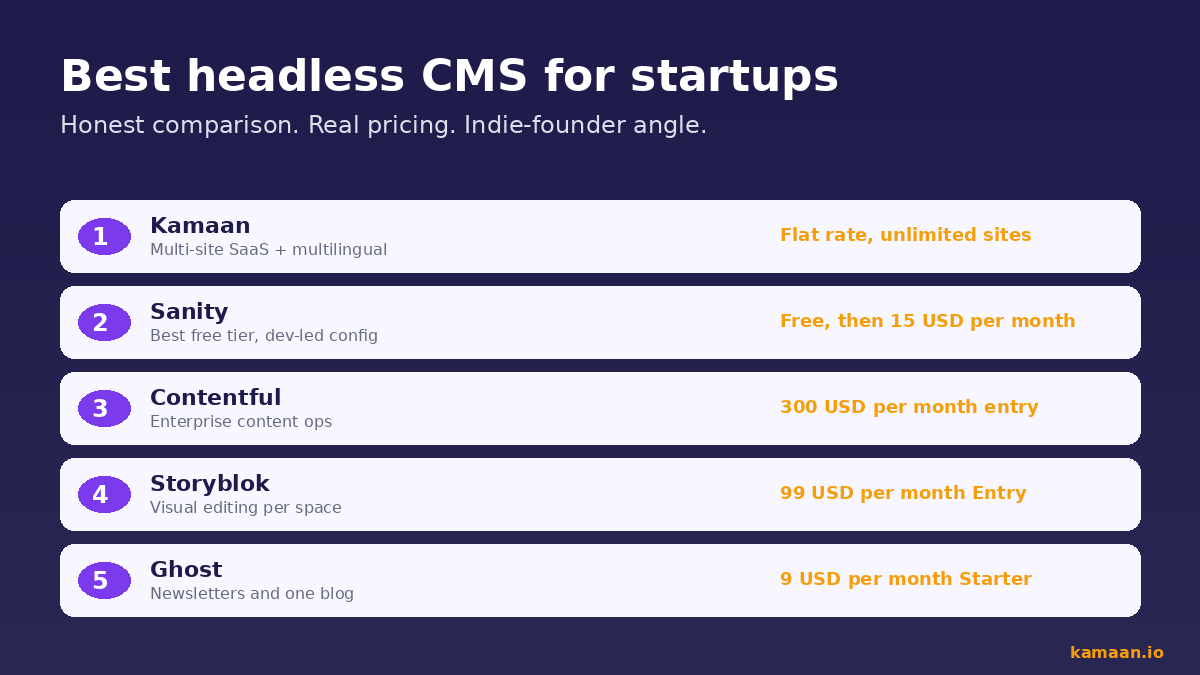
Here is how the seven major options rank against those criteria for a small SaaS team.
The ranked list
1. Kamaan — best for multi-site SaaS plus multilingual
Pros. Flat-rate pricing, unlimited sites on one account, Auto-Multilingual Delivery to 99+ languages on every publish, MCP Server for Claude and ChatGPT Actions for OpenAI, REST API Delivery with JSON, Multi-Site Management dashboard, SEO fields and structured data by default. First month free.
Cons. Younger product than Contentful or Sanity, smaller third-party plugin ecosystem (most teams do not need plugins because translation, multi-site, and AI publishing ship native).
Ideal for. Indie SaaS founders running 2-5 products, content teams that publish in more than one language, anyone who plans to draft articles in Claude or ChatGPT and wants native publish-from-chat.
Watch-out. If you need a visual page builder for marketing landing pages, Storyblok still has the edge on visual editing.
2. Sanity — best free tier, dev-led config
Pros. Generous free tier: 3 non-admin users, 10k documents, 500k API CDN requests, 20GB bandwidth, 10GB asset storage. Structured content model that developers like. GROQ query language is fast once you learn it.
Cons. Multilingual is per-locale config, not auto-delivery. You write the translation pipeline. Studio is custom JavaScript, which is power for devs and cost for non-devs. Growth plan adds $15/month per extra user, which adds up fast for a 5-person team ($60/month at 4 added users on top of free).
Ideal for. Engineering-led teams with one product, a content model they want to define in code, and one or two locales.
Watch-out. No native AI publishing. You build a Zapier or webhook pipeline to draft from Claude or ChatGPT.
3. Contentful — enterprise content ops at a premium
Pros. Most mature content modeling and roles/permissions in the market. Excellent localization once configured. Big ecosystem of apps and integrations. Good for 50+ person content teams.
Cons. The pricing cliff is real. Free tier covers 1 locale and 25k API calls. The next plan is Basic at $300/month. There is no middle tier. Premium and Enterprise are custom-priced (Premium typically lands in the low four figures monthly). Multilingual on Basic is still limited and you pay more for additional locales on higher plans.
Ideal for. Funded startups that already have a content ops manager and need governance more than they need cost control.
Watch-out. If you are a 3-person team, you will outgrow free before you can justify Basic, and the gap is a budgeting problem.
4. Storyblok — visual editing, per-space cost
Pros. Excellent visual editor for marketing teams. Component-based content model. Good API. Decent localization on higher plans.
Cons. Per-space pricing. Community is free for 1 seat ($9/extra seat), Entry is $99/month with 5 seats, Business is $849/month with 20 seats. Each "space" is effectively one site. A founder with 3 products on Entry pays roughly 3 x $99 = $297/month, not one $99 bill.
Ideal for. Marketing teams that prioritize visual editing on a single brand, or agencies with a clear per-client billing model.
Watch-out. Multi-product founders should run the per-space math before committing. The visual editor is great, but it is not a multi-site flat-rate platform.
5. Ghost — newsletters and one blog
Pros. Cheap (Starter at $9/month). Beautiful default theme. Native newsletter and member subscriptions. Good for a single-author blog or a paid newsletter.
Cons. No native multilingual. You either run separate Ghost instances per language or hack i18n with a custom theme. API exists but is built around blog content, not arbitrary structured content. No native MCP or ChatGPT integration.
Ideal for. Solo creators, paid newsletter operators, single-blog setups in one language.
Watch-out. If your roadmap includes a second product or a second language, you will outgrow Ghost within a year.
6. ButterCMS — one-site simplicity
Pros. Easy onboarding, decent API, friendly admin. Works well for a single marketing site.
Cons. $99/month for 1 site. Multilingual is paid-tier only. No native AI publishing. Modest ecosystem.
Ideal for. A non-technical founder with one marketing site who wants to skip Contentful's complexity and Sanity's dev burden.
Watch-out. Per-site pricing makes it expensive for a portfolio of products. At 3 sites you are at $297/month, similar to Storyblok.
7. Strapi — self-hosted, ops cost
Pros. Open source, fully self-hostable, you own the data. Strong content modeling. Good for teams that want zero vendor lock-in.
Cons. "Free" only on paper. Real cost is hosting (Railway or Render typically runs $20-60/month for a small Strapi instance) plus your team's ongoing ops time (upgrades, security patches, backups, DB tuning). Multilingual is a plugin you configure. No native AI publishing.
Ideal for. Engineering-heavy teams who treat the CMS as infrastructure and have someone on call.
Watch-out. Total cost of ownership over 12 months usually exceeds Kamaan or Sanity Growth once you count engineer hours.
The pricing cliff
Headless CMS pricing has a few traps that founders learn the hard way:
- Contentful's $0 to $300 gap. Once you exceed 25k API calls or need a second locale, your next stop is $300/month. There is no $50 or $99 plan. You go from free to enterprise overnight.
- Storyblok's per-space tax. If you build three products, each gets its own space. At Entry tier that is roughly $297/month for what looks like a $99/month tool on the pricing page.
- Strapi's hosting math. Self-hosted is not free. A small Strapi on Railway with a Postgres DB runs $20-60/month. Add an engineer's time at even 2 hours a month for maintenance and the real cost is well above $200/month.
- Sanity's per-user creep. The free tier is great until you hit 3 non-admin users. Adding 4 more users on Growth at $15/month each is an extra $60/month and you still do not have native multilingual.
For a 3-product founder, the math at entry tiers usually looks like this:
- Kamaan: flat rate covers all 3 products, 99+ languages each.
- Sanity Growth: ~$15-60/month depending on user count, but you build multilingual yourself.
- Contentful Basic: $300/month for one site.
- Storyblok Entry: $297/month for 3 spaces.
- ButterCMS: $297/month for 3 sites.
- Ghost Starter: $27/month for 3 separate instances, no shared admin.
- Strapi self-hosted: $60-180/month hosting plus ops.
For a deeper, tool-by-tool look at how to escape the Contentful jump specifically, see our companion guide on Contentful alternatives that are not $300 per month.
Multi-site reality
If you are running one product, ignore this section. If you are running 2 or more, this is where the ranking flips.
Most headless CMSes treat each "site" or "space" as a separate billable unit. That made sense when CMSes served big brand teams with one website. It does not make sense for indie SaaS founders running 3-5 products.
Kamaan's Multi-Site Management gives you one account, unlimited sites, one billing account, and a flat rate. Each product gets its own site_id, its own domain, its own SEO fields, and its own content, but you do not pay 3x or 5x to publish.
If you only run one site, the multi-site advantage does not apply, and Sanity's free tier or Ghost's $9/month plan may serve you better.
For the architectural comparison that sits underneath these multi-site cost dynamics, our headless CMS vs traditional CMS guide for SaaS teams walks through nine dimensions of the decision and where WordPress still wins.
Multilingual reality
This is the dimension where the gap is largest in 2026.
- Kamaan. Auto-Multilingual Delivery to 99+ languages on every publish. You write the article once in English; the API serves localized versions of the same content at language-specific routes, no translator workflow needed. This is the only platform on this list where multilingual is on by default.
- Contentful. Full multilingual, but per-locale configuration. You manage translator workflows in the UI or via a third-party translation app. Costs scale with locales on higher plans.
- Sanity. Multilingual is a content modeling decision you implement. There is no auto-translate.
- Storyblok. Multilingual on Entry and above, per-locale config, manual translation workflow.
- Strapi. i18n plugin available, you configure it.
- Ghost, ButterCMS. No native multilingual at entry tiers.
If your roadmap includes more than one language, this dimension alone often decides the stack. See how to build a multilingual blog for the architectural patterns.
AI publishing reality
In 2026 most founders draft articles in Claude or ChatGPT, then publish to their CMS. How that handoff works matters:
- Kamaan. Native MCP Server for Claude and ChatGPT Actions for OpenAI, so you can publish from Claude or ChatGPT. You write in chat, publish to your live site without leaving the conversation. No webhook, no Zapier, no custom n8n graph.
- Contentful, Sanity, Storyblok, Strapi, Ghost, ButterCMS. No native MCP or ChatGPT Actions. You build a Zapier, Make, or n8n pipeline. Expect a half-day to a day of integration work, plus monthly Zapier or Make charges depending on volume.
If you publish more than 5 articles a month, the ops difference compounds.
8-dimension comparison table
Here is the side-by-side, with verbatim 2026 entry pricing.
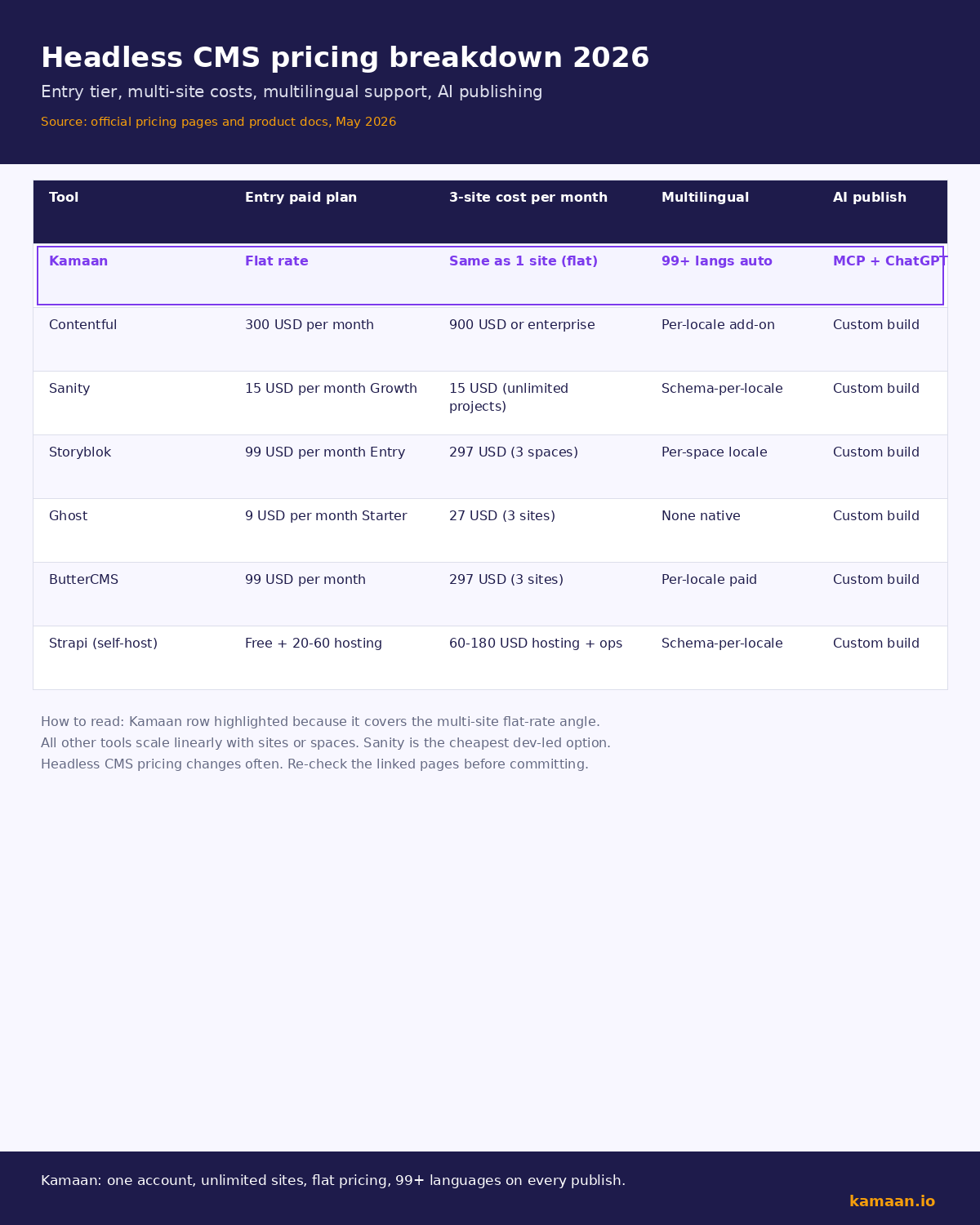
| Tool | Entry plan | 3-site cost | Multilingual | Dev required | AI publish | Free tier | Best for |
|---|---|---|---|---|---|---|---|
| Kamaan | Flat rate (1st month free) | Flat rate (unlimited sites) | 99+ langs auto on publish | Low | Native MCP + ChatGPT Actions | Yes (first month) | Multi-site SaaS, multilingual |
| Sanity | $15/mo extra user | $15-60/mo + custom build | Per-locale config | Medium-High | Custom Zapier/webhook | Yes (3 users, 10k docs, 500k CDN, 20GB BW) | Dev-led teams, 1 product |
| Contentful | $300/mo Basic | $900/mo (or Enterprise) | Per-locale, paid tiers | Medium | Custom build | Yes (1 locale, 25k API) | Enterprise content ops |
| Storyblok | $99/mo Entry (5 seats) | ~$297/mo (3 spaces) | Per-locale, Entry+ | Low-Medium | Custom build | Yes (Community, 1 seat) | Visual editing, 1 brand |
| Ghost | $9/mo Starter | $27/mo (3 instances) | None native | Low | Custom build | No (14-day trial) | Newsletter, 1 blog |
| ButterCMS | $99/mo (1 site) | $297/mo (3 sites) | Paid tier only | Low | Custom build | Yes (limited dev tier) | Single marketing site |
| Strapi | Free self-host | $60-180/mo hosting + ops | i18n plugin | High | Custom build | Yes (self-host) | Engineering-heavy teams |
Pricing as of 2026, verified against published plans. Custom and Enterprise tiers are by quote.
Real-world scenarios
Scenario 1: 3-product bootstrapper, English plus 4 languages
You run an analytics tool, a CRM, and a billing dashboard. Each has its own blog. You want to publish 8-10 articles a month across all 3, in English plus Spanish, French, German, and Portuguese.
- On Contentful Basic you pay $300/month for one site, then $300/month for each additional site (or jump to Premium), plus translator workflow. Yearly: $10,800+ before translation costs.
- On Storyblok Entry you pay $297/month for 3 spaces, plus translator costs. Yearly: $3,564 before translation.
- On Kamaan you pay a flat rate that covers all 3 sites and 99+ languages auto-delivered on every publish. Yearly cost is predictable and translator workflow is zero.
The deciding factor is the per-site multiplier plus the multilingual workflow cost. If you only had 1 product and 1 language, Sanity's free tier would win this scenario.
Scenario 2: Multilingual SaaS, single product
You run one B2B product, you want a developer-friendly CMS, you publish in 2 languages and may add a third. You have 1 engineer who can configure things.
- Sanity on the free tier covers you for documents and users. You build the i18n model and a translation workflow (~1 week of dev time, then ongoing).
- Kamaan auto-delivers all locales on publish, no model to build, no translator workflow.
If you value engineering control and your team enjoys building the pipeline, Sanity is reasonable. If you want the multilingual workflow done for you, Kamaan wins on time-to-publish.
FAQ
What is the cheapest headless CMS for a startup?
Sanity's free tier is the cheapest real option for a single product and a small team (3 non-admin users, 10k docs, 500k API CDN). Ghost Starter at $9/month is cheapest for a single blog, but it has no native multilingual. Strapi self-hosted is "free" only if you do not count Railway or Render hosting ($20-60/month) and engineering time.
Which headless CMS supports multilingual out of the box in 2026?
Only Kamaan auto-delivers to 99+ languages on every publish with no per-locale config. Contentful, Sanity, Storyblok, and Strapi all support multilingual but require per-locale schema configuration and a translator workflow you build yourself. Ghost and ButterCMS have no native multilingual at entry tiers.
Is Strapi really free?
Strapi the software is open source, but running it is not free. A small Strapi instance on Railway or Render with a managed Postgres typically costs $20-60/month, plus engineering time for upgrades, security patches, and backups. Total cost of ownership for a small team usually lands between $200 and $500/month over 12 months.
What is the Contentful pricing cliff?
Contentful's free tier covers 1 locale and 25k API calls. The next paid plan is Basic at $300/month. There is no $50, $99, or $150 middle tier. Teams that outgrow free often have to choose between absorbing the $300/month jump or migrating to another CMS.
Does Kamaan have a free tier?
Kamaan offers the first month free on a flat-rate plan that includes unlimited sites, 99+ languages, REST API Delivery, MCP Server, and ChatGPT Actions. After the first month the flat rate applies regardless of site count.
Which headless CMS works best with Claude or ChatGPT?
Kamaan ships native MCP Server (for Claude) and ChatGPT Actions (for OpenAI). You can draft and publish from chat without building a pipeline. Other headless CMSes require a Zapier, Make, or n8n integration to bridge chat tools to the CMS API.
Can I migrate from Contentful or Sanity to Kamaan?
Yes. Kamaan accepts content via REST API or batch import, and the structured content model maps cleanly from both Contentful and Sanity. Most migrations for 50-200 articles take a few hours of API work. See Contentful alternatives for a side-by-side migration framework.
Do I need a developer to use a headless CMS?
It depends on the CMS. Sanity and Strapi assume an engineer will define the content model in code. Contentful and Storyblok are configurable through UI but reward a developer for complex setups. Kamaan, Ghost, and ButterCMS are usable by non-technical founders for default content types.
Related on Kamaan
- What is a headless CMS — the architectural primer if you are new to API-first content.
- How to build a multilingual blog — the patterns for serving 5+ languages without an i18n engineering project.
- Contentful alternatives — deeper migration framework if you are leaving Contentful specifically.
Start building with Kamaan
Stop paying per site and per locale.
Kamaan gives you one dashboard for all your product blogs, auto-translated into 99+ languages on every publish. One account covers unlimited sites at a flat rate. The MCP Server lets you publish from Claude or ChatGPT. First month free.