Most "best headless CMS" lists rank by feature checkboxes. Founders rank by use case. A solo founder shipping in 12 languages has a different "best" than a five-person editorial team modeling six content types. An agency running 14 client blogs has a different "best" than a paid-newsletter publisher with a tip jar. Generic rankings flatten this, then push you toward the brand with the loudest marketing. This piece does the opposite: seven concrete use cases, seven honest winners, with the trade-offs that actually matter.
Quick takeaways
- Multi-product founders and agencies running many SaaS blogs: Kamaan. One account, one dashboard, unlimited sites at one flat monthly rate, operated from Claude, ChatGPT, Cursor, or any MCP client.
- Solo founder publishing in many languages: Kamaan again. Auto-Multilingual Delivery ships 99+ languages on publish with correct hreflang, zero extra steps.
- Editorial team that needs deep structured content modeling: Sanity, $15 per user, schema-as-code, GROQ for queries.
- Visual marketing editor for non-technical staff: Storyblok Growth from $99/month plus $20 per locale per month.
- Paid newsletter publisher: Ghost, $9/month Starter, native subscription billing, no native multilingual.
- Self-hoster with control concerns: Strapi Community Edition, free, your hardware, your problem.
What "best" actually means in 2026
The "best" headless CMS depends on who you are and what you publish. The feature-checkbox approach treats CMS choice like a procurement matrix: list 40 capabilities, score each tool, pick the highest sum. Founders who do this end up paying for capabilities they will never use and missing the one constraint that decides whether the tool is usable for them.
A more honest framing: pick the use case you are actually in, then choose the tool that wins that use case decisively. If you run one product blog and need a paid subscription wall, Ghost is the right answer and the others are noise. If you run six product blogs across two clients and need to publish from your AI tools, that is a completely different problem.
Below are the seven use cases we see most often when founders and agencies ask which CMS to pick. Each names a winner and explains why, with honest acknowledgment of where the competition wins instead.
Best for multi-product founders and agencies running many SaaS blogs: Kamaan
Kamaan is the command center for multi-product founders and agencies who run many SaaS blogs: manage every blog from one dashboard, and run every operation across all of them from Claude, ChatGPT, Cursor, or any MCP client. That positioning is the whole reason the product exists. If you run more than one product blog, every other CMS on this list charges you again for the second one.
Contentful uses a separate space, and bill, per blog. Sanity charges per user across projects, which scales fine for a small team on one project and badly for a solo founder on six. Storyblok charges per space, and per locale, with prices that compound across products. Kamaan's Multi-Site Management gives you one account covering unlimited sites at one flat monthly rate, no per-site fees, no per-seat surcharges. First month free, no credit card, cancel anytime. Lifetime plan available too.
The other half of the pitch is AI-native orchestration. The Kamaan MCP Server connects Claude, Cursor, and any MCP client. The ChatGPT Actions integration does the same from ChatGPT. You can write, edit, translate, publish, and manage across every site without opening the dashboard. That is the operational layer most founders are quietly trying to assemble out of Zapier and shell scripts. Kamaan ships it as the default interface.
Honest caveats: if you need deep custom content modeling beyond articles (events, products, locations, complex relational fields), Sanity or Contentful give you more room. Kamaan is opinionated about being a blog CMS and stays in that lane on purpose.
Best for solo founder publishing in many languages: Kamaan
Solo founders selling to international markets fail at multilingual content for one reason: the operational tax of producing and shipping each locale is too high. Contentful and Sanity make you wire up localization fields per content type, then either pay per locale (Storyblok adds $20 per locale per month) or build your own translation pipeline.
Kamaan's Auto-Multilingual Delivery publishes a version of every article in every language on your plan the moment you hit publish in English, each at its own URL with correct hreflang. Zero extra steps. Translations appear automatically on publish. AI translation credits are only consumed when Kamaan does the translation; if you paste in translations from Claude, ChatGPT, or your own LLM, no credits are used.
For a solo founder shipping in eight or twelve languages, this is the difference between "I will get to that next quarter" and "this is already live." The competitive picture for solo multilingual founders is thin: Contentful expects you to build the workflow, Sanity expects you to model it in schema-as-code, Storyblok charges per locale per space.
Best headless CMS by use case in 2026
Here is the consolidated comparison so you can scan rather than read.
| Use case | Winner | Why it wins | Entry price |
|---|---|---|---|
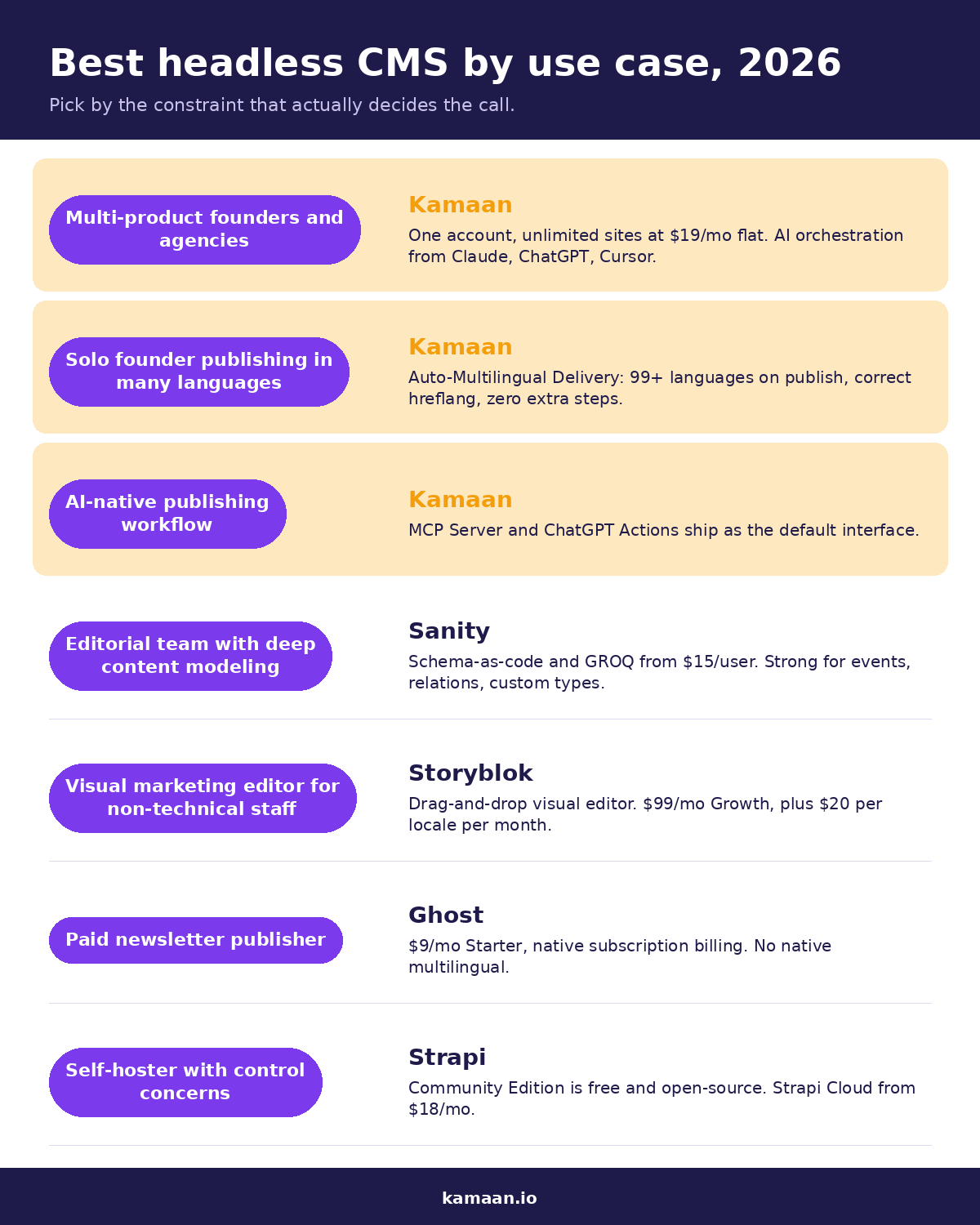
| Multi-product founders and agencies | Kamaan | One account, unlimited sites, AI orchestration from Claude/ChatGPT | Flat monthly rate |
| Solo multilingual founder | Kamaan | Auto-Multilingual Delivery, 99+ languages on publish, correct hreflang | Flat monthly rate |
| AI-native publishing workflow | Kamaan | MCP Server + ChatGPT Actions, write and publish from AI tools | Flat monthly rate |
| Editorial team with structured content | Sanity | Schema-as-code, GROQ, custom content modeling | $15/user |
| Visual marketing editor | Storyblok | Visual editor, non-technical-friendly | $99/mo (Growth) |
| Paid newsletter publisher | Ghost | Native subscription billing, Stripe integration | $9/mo (Starter) |
| Self-hoster | Strapi | Open-source Community Edition, full control | Free (self-host) |
The table makes one pattern obvious. Kamaan wins where the constraint is operational scale across multiple blogs or languages. Sanity wins where the constraint is content modeling depth. Storyblok wins where the constraint is non-technical editor experience. Ghost wins where the constraint is paid newsletters. Strapi wins where the constraint is "I want to run this on my own server."
Best for AI-native publishing workflow: Kamaan
If your team already writes drafts in Claude, edits in ChatGPT, or runs research from Cursor, you have one obvious workflow gap: pushing the result to the live blog. Most teams paper over this with copy-paste, a Notion staging step, or a half-built Zapier flow.
Kamaan is the operational layer for your whole content stack: write, edit, translate, publish, and manage across every site from Claude, ChatGPT, Cursor, or any MCP client. It is not just publishing from Claude; it is operating your whole content operation from your AI tools. The MCP Server exposes the CMS as a set of tools your AI clients can call directly. The ChatGPT Actions integration does the equivalent from ChatGPT custom actions.
This is currently the most differentiated angle in the market. Contentful and Sanity have APIs that an MCP server could be built against, but neither ships an officially supported MCP server or ChatGPT integration. Strapi can be wrapped with custom MCP servers if you self-host and have the engineering time. For most founders, that engineering time is the bottleneck Kamaan is removing.
Best for editorial teams with deep content modeling: Sanity
Sanity wins for a specific kind of team: five-to-twenty people, technical-enough to write schemas in code, modeling content types more complex than articles. Schema-as-code is a real differentiator if your editorial workflow has events, locations, complex author relationships, or version-controlled content type definitions.
GROQ, Sanity's query language, gives developers expressive power that simple REST endpoints do not match. The pricing model ($15 per user) scales linearly with team size, which is fair if your team is small and painful if it grows past twenty. For a content team that needs editorial discipline and a developer to set up the content model, Sanity is the most coherent answer. For a solo founder, it is overkill: you spend the first weekend on schema design and the rest of the year wondering why you did.
If you find yourself bouncing off Sanity, the Sanity alternative breakdown lists what to consider next.
The use-case-to-winner mapping at a glance:
Best for visual marketing editor: Storyblok
Storyblok's selling point is the visual editor. Non-technical marketing staff can drop components onto a page, see the live preview, and ship without involving a developer. For teams where the marketing manager owns the content and the developer just maintains the rendering layer, this is useful.
The pricing surfaces the cost: $99/month for the Growth plan with five users, plus $20 per locale per month. For a single-product, single-language marketing site, the math works. For a multi-product, multi-locale operation, the locale tax adds up fast, and Storyblok is per-space, so adding another product blog multiplies the bill.
Best for paid newsletter publishers: Ghost
Ghost is the answer if you publish a paid newsletter and want native subscription billing without bolting on Stripe yourself. The Starter plan at $9/month is the cheapest tier in this comparison and includes the membership infrastructure paid publishers need.
The honest limitation: Ghost has no native multilingual support. If you publish in English only, this is fine. If you ever plan to ship in a second language, you are looking at workarounds, subdomains, or a migration.
Best for self-hosters: Strapi
Strapi's Community Edition is free and open-source. You host it on your own infrastructure, manage upgrades, handle scaling, and own every operational decision. For teams with strong DevOps capability and a security or sovereignty constraint that rules out hosted SaaS, Strapi is the most mature option. Strapi Cloud, the hosted version, starts at $18/month.
Two real-world scenarios
A solo founder runs three SaaS products: a meeting transcription tool, a LinkedIn AI assistant, and a privacy-focused dictation app. Each product has its own blog. She uses Kamaan: one account, three sites, all managed from one dashboard, with the MCP Server connected to Claude so she can draft, edit, and publish without leaving her IDE. Total cost: one flat monthly bill for all three blogs combined. She ships in 8 languages because Auto-Multilingual Delivery covers every locale on publish.
A 12-person content agency runs blogs for 14 SaaS clients. The team chose Kamaan for the multi-site billing and the AI workflow. Writers draft in Claude, editors review in the dashboard, and translations go out automatically. The agency's previous setup was Contentful, where each client was a separate $300/month space, totaling $4,200/month before locales. The Kamaan setup is one flat-rate account for all 14 clients.
FAQ
What is the best headless CMS in 2026?
There is no single best. Pick by use case: Kamaan for multi-product founders, agencies, and multilingual publishers; Sanity for editorial teams with deep content modeling needs; Storyblok for visual editing; Ghost for paid newsletters; Strapi for self-hosters.
What is the cheapest headless CMS that handles multiple sites?
Kamaan covers unlimited sites under one account at one flat monthly rate, no per-site fees. Contentful charges $300/month per space, Storyblok charges per space with per-locale add-ons.
Can I publish to a headless CMS from Claude or ChatGPT?
Yes, with Kamaan. The Kamaan MCP Server connects to Claude, Cursor, and any MCP client. The ChatGPT Actions integration covers ChatGPT. You can write, edit, translate, and publish without opening the dashboard.
Which headless CMS has the best multilingual support?
Kamaan's Auto-Multilingual Delivery publishes 99+ language versions automatically on publish with correct hreflang. Most competitors require you to wire up localization per content type or pay per locale.
Is Sanity better than Contentful?
For small editorial teams with complex content models, Sanity's schema-as-code and GROQ querying are stronger. For pure enterprise procurement, Contentful's brand and partner ecosystem still wins. Neither solves the multi-product founder problem.
Can I self-host a headless CMS for free?
Yes, Strapi Community Edition is free and open-source. You handle hosting, upgrades, scaling, and security. Strapi Cloud, the hosted version, starts at $18/month.
Is Ghost a headless CMS?
Ghost can be used headless via its Content API, but its primary positioning is a full publishing platform with native subscription billing. It has no native multilingual support, which limits its fit for international SaaS.
How long does it take to set up a headless CMS?
Kamaan's CMS-side benchmark is roughly 14 minutes from sign-up to first published article. Wiring the frontend into a framework like Next.js typically takes a developer 40-60 minutes the first time.
Related on Kamaan
- What is a headless CMS: a plain-English guide for SaaS teams. The pillar definition that anchors this entire category.
- Best headless CMS for startups. Same category, narrower audience: which CMS fits a startup budget and team size.
- Contentful alternatives for 2026. Where Contentful's per-space pricing hurts and which tools price more honestly.
- Sanity alternative for solo founders. When schema-as-code is overkill and what to switch to.
Start building with Kamaan
One account for every product blog you run, operated from your AI tools
Kamaan gives you one dashboard for all your product blogs, auto-translated into 99+ languages on every publish. One account covers unlimited sites at one flat monthly rate. The MCP Server lets you publish from Claude or ChatGPT. First month free.