Sanity is a beautiful piece of structured content infrastructure. It is also, for a blog, a significant amount of work. You define every content type as code, you learn GROQ to query anything, and the moment you want a second language you discover that multilingual means a modeling decision plus a plugin. If the deliverable is a marketing blog, that is the wrong shape of effort. This guide shows what Sanity is good at today, where it stops fitting a blog, and which Sanity alternative fits which team.
Quick takeaways
- Sanity is a schema-as-code content platform. It is excellent for structured content reused across many surfaces, and heavier than a blog needs.
- Sanity's Free plan is genuinely generous: 20 seats, 2 public datasets and 10,000 documents at $0. Growth is $15 per seat per month, per Sanity's pricing page.
- Two old objections no longer hold: Sanity hosts Studio for free with
sanity deploy, and it ships an official MCP server atmcp.sanity.io. - The objections that still hold for a blog: every field is a schema change, queries are GROQ, and multilingual means choosing a localization model and installing a plugin.
- Kamaan is a headless blog CMS with the blog model built in, Auto-Multilingual Delivery with hreflang from the Growth tier up, and an MCP Server plus ChatGPT Actions on every tier.
What Sanity is, and what changed in 2026
Sanity calls itself a Content Operating System. In practice it is a hosted content backend (the Content Lake) plus Sanity Studio, an editing app you configure in code. Your schema lives in TypeScript or JavaScript files, and that schema becomes the editing UI, the API shape and the validation rules. Content is queried with GROQ or GraphQL and delivered from Sanity's CDN. So yes, Sanity is a headless CMS: it stores and delivers content, and your own front end renders it.
Three things changed recently, and older comparison pages (including earlier versions of this one) still get them wrong:
- Studio hosting is free:
sanity deploypublishes Studio to ayour-project.sanity.studioURL, and the pricing page lists Studio hosting on the Free and Growth plans. You can still self-host or embed Studio in your own app if you prefer. - The AI tooling is first-party. The Sanity MCP server runs at
https://mcp.sanity.ioand lets Claude Code, Cursor and other MCP clients run GROQ queries, create and patch documents, and manage releases. It has been in the official MCP Registry since February 2026. Content Agent and monthly AI credits are included on every plan. - Pricing is per seat. Growth is $15 per occupied seat per month, up to 50 seats, with 25,000 documents and private datasets. The full breakdown is in our Sanity pricing guide.
If you want to try Sanity's MCP server in Claude Code, it is one command:
claude mcp add Sanity -t http https://mcp.sanity.io --scope user
The friction with Sanity, for a blog
The first time you set up Sanity for a blog, the experience is fine. You run npm create sanity@latest, pick a blog starter, deploy Studio. Two months in, the friction starts to show.
Every new field is a code change. Want a second author byline, an FAQ block, a reading-time field, a category taxonomy with parent categories? Each is an edit to a schema file, a pull request, a Studio redeploy, and often a migration script to backfill existing documents. When the editor and the developer are the same person, that is fine. For a marketing team that just wants to publish posts, it is friction in the wrong place.
GROQ is the next cost. It is a good query language that nobody else on your team knows. "Show three related posts" or "list posts by tag, excluding drafts" means somebody writes GROQ, tests it in the Vision tool and ships it into the front end. The MCP server helps here, since an agent can write the query, but someone still has to own it.
Multilingual is a modeling decision. Sanity's localization guide describes two models: document-level (one document per language, linked with the @sanity/document-internationalization plugin) or field-level (internationalized-array fields). AI Assist can translate the content, but you still pick a model, wire the plugin, build the language routing in your front end and write your own hreflang tags. Most teams do the hreflang part by hand, and that is where errors creep in: missing return tags, no x-default, wrong language codes.
If you are writing those tags yourself, the free hreflang generator builds them as HTML tags, an XML sitemap block or an HTTP header, and checks existing tags for missing x-default and return-tag errors.
Where Sanity is genuinely the right choice
The honest case for Sanity first. If your content is structurally rich and reused across many surfaces (a product catalog with variants, a learning platform with lessons and tracks, an editorial site with custom workflows and approval gates), Sanity is exceptional. Portable Text, references, custom input components, real-time collaboration in Studio, and the ability to query the same content from web, app and email all pay back the configuration cost. The Free plan's 20 seats also make it hard to beat for a small team that is comfortable in code.
For a blog, none of that is the bottleneck. The bottleneck is "we want to publish a post and have it live, ranked, in the languages our customers read." That is a different job, and it is where the alternatives below differ.
Sanity alternatives compared
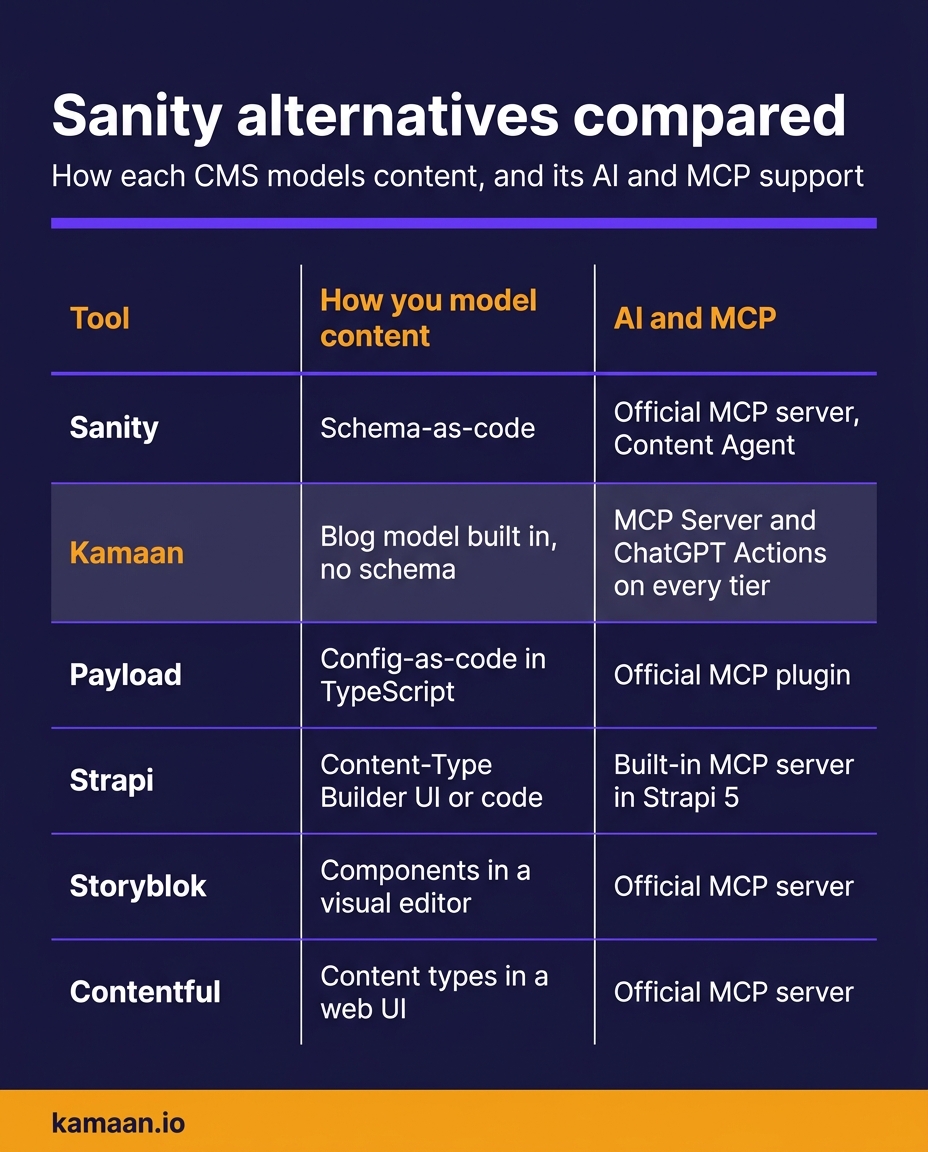
The table compares the options that come up most when teams leave Sanity. Prices change often, so the table compares how each tool works, and the notes under it link to current pricing breakdowns.
| Tool | How you model content | Hosting | Multilingual | AI and MCP | Pick it if |
|---|---|---|---|---|---|
| Sanity | Schema-as-code | Hosted Content Lake, free Studio hosting | Plugin plus your own routing and hreflang | Official MCP server, Content Agent | You need structured content across many surfaces |
| Kamaan | Blog model built in, no schema | Hosted CMS, your front end renders | Auto-Multilingual Delivery with hreflang (Growth and up) | MCP Server and ChatGPT Actions on every tier | You run one or more product blogs and want them operated from Claude or ChatGPT |
| Payload | Config-as-code in TypeScript | Self-hosted inside your Next.js app | Built-in field localization | Official MCP plugin | You want open source (MIT) and full control of the code |
| Strapi | Content-Type Builder UI or code | Self-host free, or Strapi Cloud per project | i18n built in | Built-in MCP server in Strapi 5 | You want open source with a visual schema builder |
| Storyblok | Components in a visual editor | Hosted | Locales per space, priced by plan | Official MCP server | Marketers need a visual page editor |
| Contentful | Content types in a web UI | Hosted | Locale-aware fields | Official MCP server | You are an enterprise team with budget for per-space pricing |
A few notes the table cannot carry:
- Payload joined Figma in June 2025. The open-source code is unaffected, but Payload Cloud paused new sign-ups, so plan on self-hosting. Our Payload CMS guide covers what that means in practice.
- Strapi Cloud now bills per project on its Starter, Pro and Business plans. If you are weighing it against Sanity directly, read Strapi vs Sanity.
- Contentful is the usual enterprise alternative. The Sanity vs Contentful comparison shows where its per-space model starts to cost more than Sanity's per-seat one.
How Kamaan handles the same job
Kamaan is the command center for multi-product founders and agencies who run many SaaS blogs: manage every blog from one dashboard, and run every operation across all of them from Claude, ChatGPT, Cursor, or any MCP client.
The blog model is the product. The Article CMS gives you rich text, SEO fields and scheduling, and you never write a schema. REST API Delivery returns articles as standard JSON, so your Next.js, Nuxt, SvelteKit or Astro front end fetches posts without a query language. The developer docs list the endpoints, including a translations endpoint that returns a ready hreflang array.
Multilingual is where the difference is largest. Auto-Multilingual Delivery publishes a version of every article in every language on your plan the moment you publish in English, each at its own URL with correct hreflang. There is no plugin to choose and no localization model to design. It starts on the Growth tier, and the number of languages scales with the tier.
The AI side works from every tier. The MCP Server connects Claude, Cursor and any MCP client, and ChatGPT Actions does the same from ChatGPT, so you can write, translate and publish without opening a dashboard. Multi-Site Management puts every product blog under one account, up to 30 sites on the Unlimited tier. Plans and the current first-month-free offer are on the pricing section.
Kamaan does not let you model arbitrary content types, and it has no Portable Text with custom annotations. If your content is a catalog or a course platform, stay on Sanity. A blog rarely needs either.
Real-world scenarios
A two-person founder team picks Sanity because a friend recommended it. Week one, the starter blog runs. Week two, they add categories, an author bio and a related-posts block: two pull requests, a Studio redeploy and a migration. Week three, they want Spanish and German, so they choose document-level localization, install the plugin, rework the routing in their Next.js app and write hreflang by hand. On Kamaan Growth, the same team publishes in English and the Spanish and German versions arrive on publish with hreflang already in place, so week two goes into writing.
An agency runs blogs for twelve SaaS clients. On Sanity, that is twelve projects, each with its own seats and schema to keep in sync. On Kamaan Unlimited, every client blog sits in one account, and the team drafts and publishes across all of them from Claude.
FAQ
Is Sanity a headless CMS?
Yes. Sanity stores content in its hosted Content Lake and delivers it through APIs (GROQ, GraphQL and a CDN), while your own front end renders the pages. The editing app, Sanity Studio, is configured in code and can be hosted free by Sanity or self-hosted.
Is Sanity free?
Sanity's Free plan is $0 with 20 seats, 2 public datasets, 10,000 documents and free Studio hosting. Growth is $15 per seat per month and adds private datasets, 25,000 documents, comments, tasks and scheduled drafts. Usage beyond the included API requests and bandwidth is billed separately on paid plans.
Can I self-host Sanity?
You can self-host Sanity Studio, the editing app, or embed it in your own app. The content itself always lives in Sanity's hosted Content Lake, so Sanity is not a fully self-hosted CMS. If you need the database on your own servers, look at Payload or Strapi.
What is the best open-source Sanity alternative?
Payload and Strapi are the two most common picks. Payload is MIT-licensed and runs inside your Next.js app; Strapi is open source with a visual Content-Type Builder and an optional paid cloud. Both are code-heavier than a hosted blog CMS, since you run the server.
Does Sanity have an MCP server?
Yes. Sanity's official MCP server runs at https://mcp.sanity.io and lets AI agents query content with GROQ, create and patch documents, upload assets and manage releases. Kamaan's MCP Server does the blog-specific version of this, and Kamaan adds ChatGPT Actions for ChatGPT users.
How does Sanity handle translations and hreflang?
Through plugins. You choose document-level localization (@sanity/document-internationalization) or field-level (internationalized-array), and AI Assist can translate content. The language routing and hreflang tags are built in your front end. Kamaan's Auto-Multilingual Delivery handles both on publish from the Growth tier up.
Can I migrate a blog from Sanity to Kamaan?
Yes, with some scripting. Export your dataset with sanity dataset export production blog.tar.gz, convert the Portable Text bodies to Markdown, then publish the articles into Kamaan, either by hand or by having Claude publish them through the Kamaan MCP Server. Keep the same slugs so existing URLs keep working.
When should I stay on Sanity?
Stay if your content is reused across a website, an app and other channels, if editors need custom input components or real-time co-editing, or if your team is comfortable owning a schema in code. For a blog that mostly needs to ship posts in several languages, a blog-shaped CMS is less work.
Related on Kamaan
- What Is a Headless CMS. The plain-English pillar guide this comparison builds on.
- Sanity Pricing Explained. Per-seat billing, free plan limits and where usage costs appear.
- Strapi Alternatives. Hosted options for teams leaving a self-hosted CMS.
- Contentful Alternatives. The same question asked of Sanity's biggest rival.
Start building with Kamaan
A blog CMS with no schema to write
If your job is a blog and your team is small, schema-as-code is a developer tax that buys nothing you need. Kamaan ships the blog model, Auto-Multilingual Delivery and the MCP Server as the product, so you publish from Claude or ChatGPT and every language on your plan goes live with hreflang. First month free.