Contentful is the default headless CMS recommendation for serious teams, and it is also the reason most small SaaS teams shelve their headless plans. The free tier is generous, then the next paid tier jumps to roughly $300 per month (some published lists now put the Lite plan closer to $489 annualised). There is no $50 or $100 step in between. If your blog needs more than 5 users, more than a couple of languages, or a second site, you are immediately negotiating with sales for four figures a month.
This guide walks through six Contentful alternatives that solve real headless CMS problems without the four-figure jump. Each tool is rated on price, multilingual support, multi-site behaviour, API quality, and how long it takes a founder to ship a working blog with it.
Quick takeaways
- Contentful's first paid tier sits at around $300 per month after the free plan, with no middle option, which is the single biggest reason teams look elsewhere.
- Kamaan covers unlimited sites and 99+ languages on every publish at one flat monthly rate, with the first month free.
- Sanity is cheaper for small teams ($15 per user) but charges in engineering hours: every content type is schema-as-code.
- Storyblok charges per space and per locale, which can easily reach $300 to $500 a month once a founder runs 3 products in 4 languages.
- Strapi is free as self-hosted open source, but you own the server, the upgrades, and the on-call.
- Ghost is the cleanest pure-blog option for publishers, but has no native multilingual and was not designed as a headless API CMS.
- ButterCMS keeps user counts unlimited and pricing predictable, but its entry tier is single-site only.
Why Contentful pricing pushes small teams out
Contentful's published price points work for two kinds of buyer: a hobbyist on the free plan, and an enterprise content team with a budget line. The middle is where the gap sits. The Lite or Team tier starts at roughly $300 per month at list (Vendr and other procurement trackers cite list rates near $489 per month annualised), and is gated to a fixed user count, a fixed locale count, and one space. Going past any of those limits puts you in a Premium or Enterprise conversation, which is rarely below $2,000 per month.
For a SaaS founder with three small products, this is structurally wrong. The cost is not tied to the value delivered, it is tied to seat and space lines that exist because the model was built for enterprise content ops, not for indie SaaS blogs. The result is predictable. Founders either stay on the free plan and tolerate the limits, or they leave for a tool whose pricing curve actually matches a small team's reality. That is what these six alternatives are for.
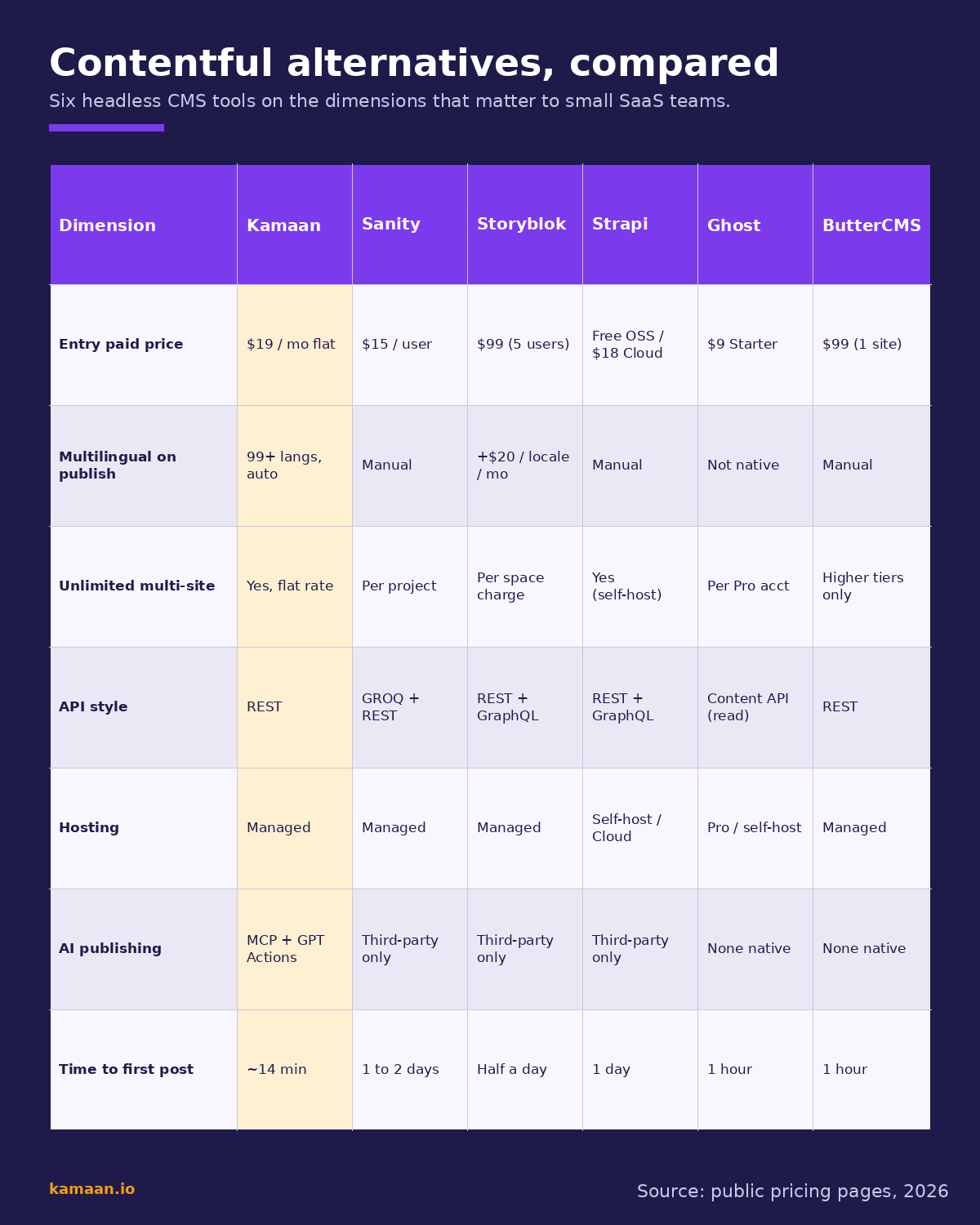
The honest comparison table
The card above summarises the question this guide answers: which six tools actually compete with Contentful at a price a small SaaS team can live with.
Six tools, eight dimensions, real numbers. This table is the reference asset of the article. Everything below it is context for the rows.
| Dimension | Kamaan | Sanity | Storyblok | Strapi | Ghost | ButterCMS |
|---|---|---|---|---|---|---|
| Entry paid price (USD/month) | Flat monthly rate, first month free | $15 per user | $99 (5 users) | Free self-hosted, $18 Cloud | $9 (Starter) | $99 (single site) |
| Multilingual on publish | 99+ languages, automatic | Manual per locale | $20 per locale per month | Manual | Not native | Manual |
| Multi-site (unlimited) | Yes, flat rate | Per project | Per space charge | Yes (self-managed) | Per Pro account | Higher tiers only |
| API style | REST, framework-agnostic | GROQ + REST | REST + GraphQL | REST + GraphQL | Content API (read) | REST |
| Hosting model | Managed | Managed | Managed | Self-host or Cloud | Managed (Pro) or self-host | Managed |
| AI publishing (Claude, ChatGPT) | MCP Server + ChatGPT Actions | Third-party only | Third-party only | Third-party only | None native | None native |
| Setup time to live blog | ~14 minutes | 1 to 2 days (schema config) | Half a day | 1 day | 1 hour | 1 hour |
| Best fit | SaaS founders running multiple multilingual sites | Editorial teams who want full structure control | Marketing teams who edit visually | Engineers who want full control | Publishers monetising via newsletters | Single-site SaaS sites |
Numbers above reflect the public pricing pages of each tool as of 2026, plus what independent procurement and review sites (Vendr, ButterCMS, Hygraph's own comparison post) currently cite. Pricing on enterprise tiers is negotiated, so the published list is a floor, not a ceiling.
The 6 Contentful alternatives, one by one
1. Kamaan: the multilingual, multi-site, AI-native option
Kamaan is a headless blog CMS that lets SaaS teams publish once and auto-deliver to 99+ languages, manage unlimited sites from one account, and write blog posts directly from Claude or ChatGPT. It is the only tool on this list that ships native AI publishing through an MCP Server and ChatGPT Actions, and the only one whose multilingual story is "publish in English, the other 99+ languages appear automatically."
Pricing is one flat monthly rate. One account covers unlimited sites, with no per-site fees, no per-space charges, and no per-seat upgrades. The first month is free, no credit card to start, cancel anytime. A lifetime plan is also available: pay once, keep your account forever. AI translation credits only come into play if you ask Kamaan to handle translations for you; if you bring translations from Claude, ChatGPT, or your own LLM and upload them, no credits are consumed. For a founder running 2 to 4 SaaS products that all need a blog in 4 to 5 languages, the price difference against Contentful is roughly 15x ($19 vs $300 at Contentful's first paid tier).
The trade-off, in fairness: Kamaan is a blog CMS. It does not try to be a marketing site builder, a product content store, or a structured content platform for arbitrary domain models. If you need to manage product catalogue data with custom relationships, Sanity or Contentful are better fits. If your CMS needs are a blog plus a few standalone pages per product, Kamaan was built exactly for that shape. Kamaan is currently in private beta, opening 50 founder slots in Q3 2026; the request-a-slot link sits on the homepage.
2. Sanity: when you want full content modelling, and you have engineers
Sanity's per-user pricing of $15 is the friendliest entry point on this list for small teams. It is structured content done seriously: every content type is defined in code (schema-as-code), every change to that schema is a deployment, and the editing UI (Sanity Studio) is itself a React app you customise. The query language is GROQ, which is powerful and unfamiliar.
For a team with an engineer ready to spend a couple of days defining schemas, validation rules, and references, Sanity gives you complete control. For a SaaS founder who wants a blog up tomorrow morning, schema-as-code is overkill. There is no "create a blog post" wizard, because Sanity does not assume you want a blog. You teach it that a Post has a title, a body, a slug, an author reference, and an SEO sub-object, and you write the validation rules yourself.
Sanity's multilingual story is also a "configure it yourself" story: you decide whether locales are fields on a document, separate documents linked by reference, or another pattern. It works, but it is engineering time on day one and on every schema change after that.
If the friction you keep hitting with Sanity is schema-as-code and bring-your-own multilingual for what is fundamentally a blog, the no-config angle is covered in detail in our Sanity alternative write-up.
3. Storyblok: the visual editor option, with per-space pricing
Storyblok's main differentiator is the visual editor: a marketing person can edit a page, see what it will look like in real time, and publish without touching code. For teams whose primary editors are non-technical marketers, this is a significant time saver.
The pricing model is the catch. Storyblok charges per space (which functionally means per site), and per locale. The Growth tier is $99 a month for 5 users, but additional locales are $20 each per month and additional spaces are billed separately. A founder running three products that each need 4 locales is already past $300 a month before user counts come into play, which is the cost ceiling they came to escape Contentful for.
Storyblok is the right tool if your blog is one site, your editing team is visual-first, and your multilingual count is small. It is the wrong tool for a 3-product, 5-language founder.
The infographic below compares all six options on the dimensions that matter to a small SaaS team.
4. Strapi: open source, you own the server
Strapi is the leading open-source headless CMS, and its Community Edition is free forever with unlimited content types, unlimited API calls, and unlimited entries. You self-host it. That sentence has two halves: "free forever" and "you self-host it." The first is the appeal, the second is the cost.
Self-hosting a CMS in 2026 means owning the database, the file storage, the upgrade path, the security patches, the backup strategy, and the on-call rotation when something breaks at 2am. For an engineering team with infrastructure expertise, this is no problem. For a founder whose product is the priority, it is a quiet tax that grows every month.
Strapi Cloud is the managed version, starting at around $18 per month. It is competitive at the entry tier, though limits on content entries and API calls mean the price climbs as the blog grows. Multilingual support exists but is a plugin you configure, not an automatic on-publish behaviour.
5. Ghost: the cleanest pure-blog option, with caveats
Ghost was built as a publishing platform with monetisation built in: newsletter sends, paid memberships, recurring subscriptions. For a publisher whose business model is paid content, Ghost is excellent and inexpensive (Ghost Pro Starter is $9 per month).
For a SaaS founder using a blog as a marketing channel, Ghost has two structural mismatches. First, multilingual is not native: it is achieved through third-party themes or by running multiple Ghost instances, neither of which compares to publish-once auto-translation. Second, Ghost is primarily a writing platform with a content API for reading: it was not designed to be the structured content backbone of a separate product surface.
If your blog is its own thing, in one language, and you are open to using Ghost themes for the frontend, Ghost is a clean and cheap option. If you want a CMS that feeds a SaaS product's marketing site, this is not the fit.
6. ButterCMS: predictable pricing, single-site entry
ButterCMS keeps user counts unlimited across all plans, which removes a cost surprise that hits with Contentful and Sanity. The entry tier is $99 per month and is single-site. Multi-site requires a higher tier, which means a founder running multiple products quickly leaves the entry price behind.
ButterCMS is fastest to ship for a single-site SaaS where the blog is one of several CMS-managed surfaces. It does not offer the multilingual auto-delivery story or the AI publishing surface that Kamaan does, but its API is clean and its hosted model is reliable.
Real-world scenarios
A bootstrapped founder running three SaaS products (an invoicing tool, a scheduling app, a small CRM) publishes blog updates for all three from a single Kamaan dashboard. One account, one monthly invoice, no per-site fees. Each article goes live on all three domains with their respective language sets (English plus Spanish, German, French, and Italian). The same founder on Contentful would be at $300 a month at the Lite tier per space, with locales and seats negotiated separately, before any of the three sites is fully wired up.
A founder publishing one weekly blog post writes the article in a Claude conversation, has Kamaan's MCP Server publish it as a draft, refines the headline in chat, then publishes. Within seconds of hitting publish, Kamaan auto-delivers Spanish, German, French, and Italian versions at /es/blog/, /de/blog/, /fr/blog/, /it/blog/, each with correct hreflang. Google indexes all five within 48 hours. The founder did not write a single word in a second language and did not open a CMS dashboard.
How to pick from this list in 60 seconds
The decision tree is short. If your blog is one site in one language and the product is paid newsletters, use Ghost. If your blog is a small structured content domain that an engineer will model, use Sanity. If you have a marketing team that needs a visual editor and your multilingual count is small, use Storyblok. If you want to self-host and own the infrastructure, use Strapi. If your blog is single-site and you want clean predictable pricing, use ButterCMS. If you run multiple SaaS products, need true multilingual on publish, and want to write articles inside Claude or ChatGPT, use Kamaan.
The first month on Kamaan is free, which is the cheapest way to find out if the fit is real.
FAQ
Is Contentful really $300 a month at the first paid tier?
Contentful's first paid tier is published around $300 per month (list pricing at the Lite or Team level, with some procurement trackers citing closer to $489 annualised). There is no $50 or $100 plan between Free and the first paid step, which is the cost cliff most teams describe.
What is the cheapest Contentful alternative for a single-site blog?
Ghost Starter at $9 per month is the cheapest hosted option for a single-site blog. ButterCMS at $99 per month is the cheapest hosted option that is built as a true headless CMS for a single SaaS site.
Which Contentful alternative supports multiple languages without extra cost?
Kamaan is the only tool on this list that auto-publishes to 99+ languages on every English publish under a flat plan. Storyblok charges $20 per locale per month, Sanity treats locales as a content modelling decision you implement, Strapi exposes locales through a plugin, Ghost has no native multilingual, and ButterCMS treats locales as a plan-tier upgrade.
What is the best Contentful alternative for AI-native publishing?
Kamaan ships an MCP Server and ChatGPT Actions integration that lets you publish posts directly from Claude or ChatGPT without opening a dashboard. No other tool on this list offers this natively in 2026.
Is Sanity actually cheaper than Contentful?
Sanity's $15 per user pricing is cheaper at the entry tier for small teams. For 3 users you are at $45 per month against Contentful's $300+. The hidden cost is engineering hours: every content type is schema-as-code, and the editing UI is a React app you maintain. If those hours are cheaper than the price difference, Sanity is the better deal. If a founder is doing the work, it usually is not.
Can I migrate from Contentful to another headless CMS easily?
Most headless CMS tools accept JSON imports, so the technical migration is straightforward. The harder part is content modelling differences: if your Contentful schema uses many references and rich text embeds, those have to map onto the new tool's data model. For a blog-only Contentful instance, migration to Kamaan or Ghost is typically a one-day job.
What if I just want to self-host to avoid SaaS pricing entirely?
Strapi Community Edition is free, open-source, and runs on infrastructure you own. The cost moves from a monthly bill to engineering time: upgrades, security patches, backups, scaling, and uptime. For most founders, the time cost exceeds the SaaS bill within 6 months.
Why is Contentful so expensive in the first place?
Contentful's pricing is structured for enterprise content teams managing thousands of content entries across many surfaces. Seats, spaces, and roles are the units that scale revenue for them. For a small SaaS team running a single blog, the model charges for capabilities the team does not use, which is where the mismatch comes from.
Related on Kamaan
-
Best headless CMS for startups. The honest comparison pillar this article expands on.
-
What is a headless CMS. Plain-English explanation of the category before evaluating tools.
-
How to add a blog to your SaaS product. The developer setup guide once you have picked a CMS.
-
How to build a multilingual blog. The companion guide for the multilingual-first audience.
-
Multi-site CMS: one account, multiple domains. The companion article that puts real monthly numbers on per-space billing across three SaaS sites. Kamaan's flat rate versus the rest.
-
Contentful pricing explained. The tier-by-tier breakdown of what Contentful actually costs at Free, Team, Premium, and Enterprise, with real founder scenarios.
Start building with Kamaan
One account, unlimited sites, 99+ languages on every publish
Kamaan gives you one dashboard for all your product blogs, auto-translated into 99+ languages on every publish. One account covers unlimited sites at a flat rate. The MCP Server lets you publish from Claude or ChatGPT. First month free.