A SaaS founder picks a URL pattern for the multilingual blog on day one and lives with the consequences for years. Pick the wrong one and Google treats every translated article as a separate, lower-authority page. Pick the right one and the same articles inherit the domain authority of the marketing site they already share. The choice is small in code, huge in compounding effect.
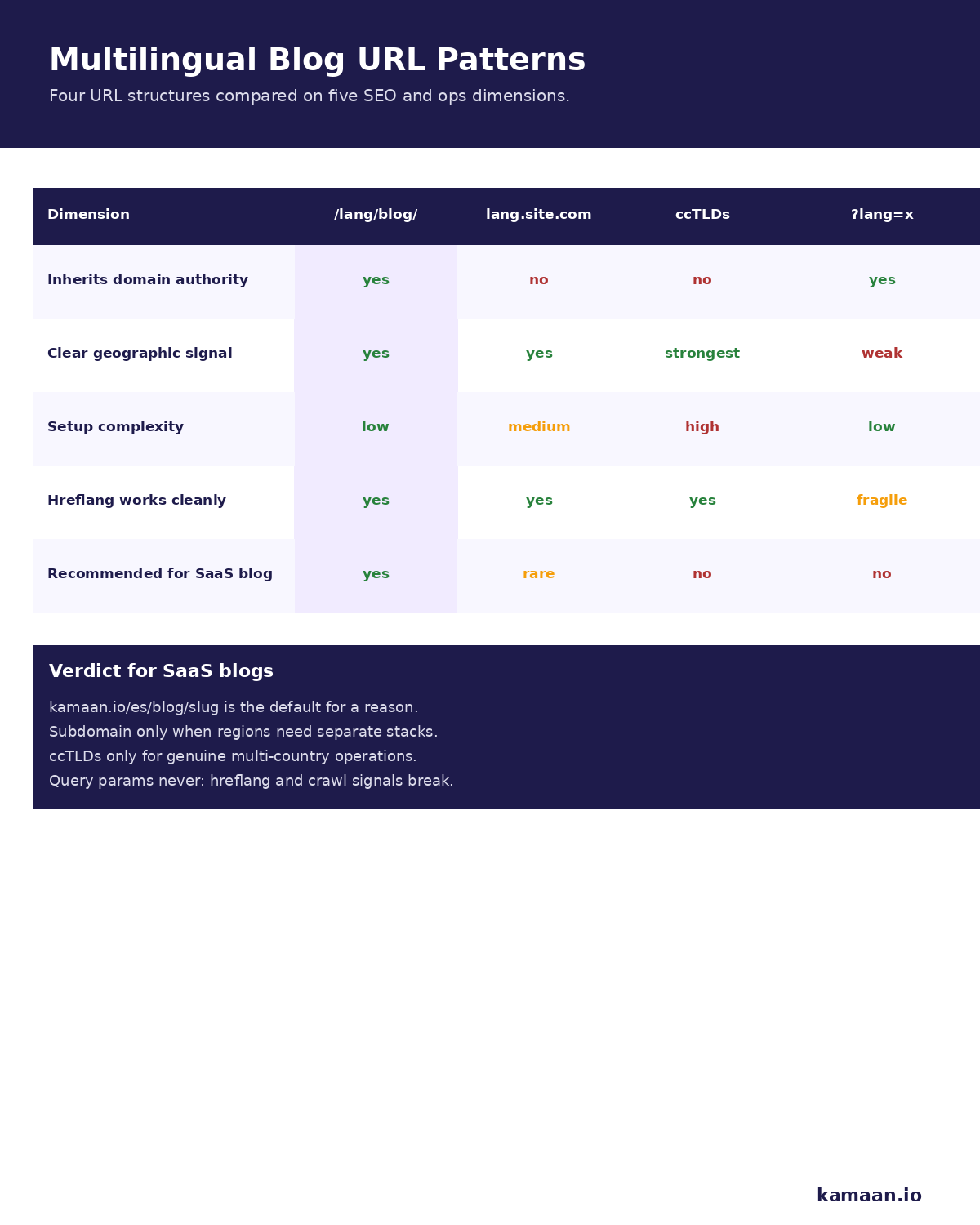
This article is the structured decision. Four patterns are in play: subfolder (kamaan.io/es/blog/slug), subdomain (es.kamaan.io/blog/slug), ccTLD (kamaan.es/blog/slug), and query parameter (kamaan.io/blog/slug?lang=es). Three of them work in narrow cases. One is the default for SaaS blogs in 2026. The argument is below.
Quick takeaways
- Subfolders (/es/blog/slug) inherit the root domain's authority and are the default for SaaS blogs. Setup is trivial, hreflang is clean, and the blog rides the same SEO equity as the marketing site.
- Subdomains (es.kamaan.io) make sense only when each region needs a separate stack, separate ownership, or legal isolation. The translated subdomain accumulates authority slowly because Google treats it as a distinct host.
- ccTLDs (kamaan.es) are for genuine multi-country operations with local entities. The strongest geographic signal, the highest setup cost, and the slowest authority compounding.
- Query parameters (?lang=es) break crawl semantics, fragment hreflang, and produce duplicate-content signals. Avoid for any indexable content.
- Kamaan's Auto-Multilingual Delivery defaults to subfolder URLs (/es/blog/, /de/blog/, /fr/blog/, /it/blog/) with correct hreflang emitted server-side, so the decision is made and implemented in one step.
The four URL patterns at a glance
Each pattern is a different answer to a single question: where, in the URL, does the language live? The four answers, with the structural consequences each one carries:
Subfolder. kamaan.io/es/blog/slug. The language sits as a path segment between the host and the rest of the URL. From Google's perspective, this is the same host as kamaan.io. PageRank, trust signals, and backlinks to kamaan.io flow to the subfolder. Hreflang is straightforward: every language version is an alternate URL on the same host. The blog rides the marketing site's authority.
Subdomain. es.kamaan.io/blog/slug. The language is part of the host. From Google's perspective, this is a distinct host. Authority does not flow automatically between hosts. The Spanish subdomain starts with zero domain authority and builds its own. Hreflang still works, but each language version must accumulate signals separately.
ccTLD. kamaan.es/blog/slug. The country is the entire domain. The strongest possible geographic targeting signal. Each ccTLD is a completely separate site that must be operated, hosted, and ranked on its own. Authority accumulates per-country, slowly. Setup involves separate DNS, separate SSL, often separate legal entities.
Query parameter. kamaan.io/blog/slug?lang=es. The language is a URL parameter. Google often, but not always, treats ?lang=es as the same page as the base URL. Hreflang annotations on parameterized URLs are fragile. Different parameters can produce conflicting canonical signals. Most CDNs strip or ignore parameters when caching. The crawl story is messy at best.

Why subfolders win for SaaS blogs
Three reasons, in order of importance.
Authority inheritance. A SaaS marketing site is a single domain with a single authority profile. The blog is part of that profile, not a separate entity. Subfolders keep the blog inside that profile. Backlinks to kamaan.io's homepage, product pages, and existing blog posts all contribute to the authority of /es/blog/slug because it sits at the same host. The Spanish version starts with whatever ranking power the English version already has on Google's books.
Operational simplicity. One DNS entry. One SSL certificate. One CDN configuration. One sitemap host. One Search Console property covering everything. Adding a new language is a routing change in the frontend, not a new host to provision. For a small SaaS team this is the difference between shipping multilingual in an afternoon and shipping it in a sprint.
Hreflang cleanliness. Hreflang annotations are simplest when all versions of a page are on the same host. Cross-host hreflang works but is more prone to errors. Same-host hreflang is something Google tools verify in minutes, and a free hreflang tag generator makes producing the annotations in the first place just as quick. The fewer cross-domain edges in the hreflang graph, the fewer chances for the implementation to drift.
Google's John Mueller has stated repeatedly that the difference between subfolders and subdomains is small from a pure ranking standpoint. The operational and authority-inheritance arguments are where subfolders actually pull ahead for SaaS.
When a subdomain is the right call
Three legitimate cases for subdomains, and almost nothing else.
Separate technical stacks per region. The German marketing site runs on a different platform from the rest of the company because the German subsidiary inherited it through an acquisition. Forcing it into a subfolder would require a re-platform that nobody wants to fund. A subdomain isolates the technology stack without breaking the brand.
Separate ownership or legal autonomy. Each region is operated by a different team, sometimes a different legal entity. The teams want full control over their content and infrastructure without coordinating on a shared host. Subdomains let each team operate independently while sharing the parent brand.
Aggressive regional SEO experiments. Subdomains are the cleanest way to A/B test SEO strategies that affect site structure without polluting the main site's signals. Use this only when the testing program is mature.
In every other case the subdomain costs you authority inheritance and gains you nothing. The marketing equity of kamaan.io does not transfer to es.kamaan.io. The Spanish version has to earn its rankings from scratch.
When ccTLDs are actually required
ccTLDs are the right choice when the company operates as separate businesses in each country. Different inventory, different pricing, different legal terms, possibly different brands. Amazon does this: amazon.de, amazon.co.uk, amazon.fr each operate as standalone storefronts with country-specific catalogs.
For a SaaS product, ccTLDs are rarely the right answer. The product is the same everywhere. The pricing is in one currency or a clear conversion. The legal structure is one entity. Splitting the marketing site across ccTLDs creates four to fifteen separate sites that all need their own authority, their own backlink campaigns, their own content ops. The geographic targeting benefit is real but the operational overhead is enormous.
A useful test: if you cannot name three things that are genuinely different in the German operation versus the English one (beyond translation), you do not need a ccTLD.
Why query parameters break the indexing story
The query-parameter approach is appealing because it requires almost no infrastructure changes. The framework already routes kamaan.io/blog/slug; adding ?lang=es is a single line of code. The problem is what Google does with that URL.
Google's default treatment of query parameters is to treat them as the same canonical URL unless something explicit tells it otherwise. The ?lang=es variant may not be indexed at all. Even if it is indexed, hreflang annotations on parameterized URLs are unreliable: many implementations of hreflang in the head do not survive the parameter parsing logic in Google's crawler. CDNs sometimes cache parameter-stripped versions, returning the English content to readers who clicked the Spanish link. Analytics gets fragmented across parameter combinations.
For non-indexable preferences (UI language toggle for logged-in users, for example), query parameters are fine. For the public marketing blog where Google indexing is the entire point, they are not. The decision tree is short: if you want Google to rank a translated version, the URL must be a clean, parameter-free path.
What Kamaan emits by default
Kamaan's Auto-Multilingual Delivery feature defaults to the subfolder pattern. When you publish an English article at kamaan.io/blog/auto-translate-blog-posts, the Spanish, German, French, and Italian versions go live at kamaan.io/es/blog/auto-translate-blog-posts, kamaan.io/de/blog/auto-translate-blog-posts, kamaan.io/fr/blog/auto-translate-blog-posts, and kamaan.io/it/blog/auto-translate-blog-posts. The slug is transliterated to ASCII when the focus keyword is translated, so accented characters never break the URL.
Hreflang annotations on every version point at every other version including itself. The sitemap.xml includes every translated URL with the correct hreflang annotation. The canonical URL on each version points at that version, not at the English original.
That is the entire decision. You do not pick a URL pattern; the CMS publishes to the pattern that has been the right answer since at least 2017 and remains the right answer in 2026.
Two real workflows
A bootstrapped SaaS founder writes an article in Kamaan, hits publish in English, and within minutes has live URLs at kamaan.io/blog/..., kamaan.io/es/blog/..., kamaan.io/de/blog/..., kamaan.io/fr/blog/..., kamaan.io/it/blog/.... Search Console picks up the alternates within 48 hours. The founder did not configure DNS, did not set up additional Search Console properties, did not write a single line of routing logic.
An agency runs three SaaS clients on subfolder patterns from one Kamaan account. Each client has its own domain. Each client has its own four target languages. Twelve sets of URLs go live each week. The agency operator never touches DNS for any of them: each client's frontend is already configured to route /lang/blog/ and Kamaan handles the rest.
FAQ
Is the subfolder vs subdomain decision still relevant in 2026?
Yes. The technical machinery hasn't changed since the late 2010s, and Google's published guidance still treats subfolders and subdomains as distinct hosts. The compounding-authority argument that favours subfolders has actually grown stronger as core algorithm updates have made domain-level trust more important relative to page-level signals.
Can I switch from query parameters to subfolders later?
Yes, with 301 redirects from every old parameterized URL to the new subfolder URL. The catch is that the old parameter URLs were probably not well indexed in the first place, so the migration recovers very little authority. The fix usually means starting the SEO clock over on the translated versions.
What about regional variations of the same language, like es-MX vs es-ES?
If the content is genuinely different per region, use a region-and-language path like /es-mx/blog/ and /es-es/blog/. If the content is the same, use the language-only path /es/blog/ and let Google figure out which region to serve. Most SaaS blogs do not have region-specific Spanish content.
Does Kamaan support subdomains or ccTLDs if I need them?
Kamaan emits subfolder URLs by default because that is the right answer for almost every SaaS blog. If a specific deployment needs subdomains, the REST API delivers content with locale fields you can route under whatever subdomain structure you operate. Ccdomain TLD operation requires running a separate site per country and is outside the default flow.
How does Kamaan handle the hreflang annotations?
Every translated version emits hreflang link tags in the head pointing at every other language version, including a self-reference. The same annotations appear in sitemap.xml. The annotations re-flow automatically when you edit the English version and the translations re-publish.
Will Google penalize me for switching URL patterns later?
Not directly. Google publishes guidance for site migrations, and a well-executed migration with comprehensive 301 redirects preserves most authority. The hidden cost is the months it takes the redirects to settle and the freshness signals to re-baseline. Picking the right pattern at the start is much cheaper than migrating later.
Related on Kamaan
- How to Build a Multilingual Blog: A Complete Guide for SaaS Products. The full setup guide that this article fits inside: architecture, content workflow, sitemap, and hreflang.
- Multilingual SEO: What It Is, Why It Matters, and How to Get It Right. The broader SEO context: ccTLD vs subdomain vs subfolder in the international SEO landscape.
- Hreflang Tags Explained: The Right Way to Set Them Up for a Blog. The mechanics of hreflang in HTML head, sitemap.xml, and HTTP headers.
- Auto-Translate Blog Posts: What Works, What Breaks, and What Kamaan Does Instead. The companion piece on the translation engine that fills the URLs you just chose.
Start building with Kamaan
Subfolder URLs, correct hreflang, sitemap entries, all handled at publish
Kamaan gives you one dashboard for all your product blogs, auto-translated into 99+ languages on every publish. URLs ship at /lang/blog/slug on your existing domain. One account covers unlimited sites at one flat monthly rate. First month free.