You translate the article, push it live, and wait. Three months later it ranks for nothing. The German version cannibalizes the English one. Google's Search Console shows hreflang errors on every URL. This is the default outcome for SaaS teams that treat multilingual SEO as "publish a translation and call it international." It is not enough. Multilingual SEO is a discipline with three layers that all have to work: URL structure, hreflang annotations, and the translation method itself.
This guide walks through what each layer means, how to get it right in 2026, and why 75 percent of international sites have hreflang errors that quietly cap their rankings.
Quick takeaways
- Multilingual SEO is the practice of ranking the right language version of your content in the right country, without cannibalizing your own rankings or triggering duplicate-content penalties. URL structure, hreflang, and translation method are the three layers that decide if it works.
- The default URL structure for most SaaS teams is the subfolder pattern: example.com/de/blog/. It consolidates link equity to one domain, signals language clearly, and avoids the maintenance overhead of separate ccTLDs.
- Hreflang has three non-negotiable rules: self-reference, symmetry, and valid ISO codes. A single broken cluster causes Google to ignore the entire annotation block. Roughly 75 percent of international sites have at least one hreflang error.
- Machine translation alone is not a multilingual content strategy. Google detects thin auto-translated content and demotes it. The 2026 default is quality-tuned translation with native review on the surfaces that matter.
- Kamaan's Auto-Multilingual Delivery ships 99+ languages on every publish, with hreflang and locale-prefixed URLs emitted server-side. The skill that takes most SaaS teams 12 months to learn is done for you on day one.
What multilingual SEO actually is
Multilingual SEO is the practice of making sure each language version of your content ranks for the right queries, in the right market, without competing against your other language versions for the same query. It sits on top of three layers:
URL structure tells Google which language each page is for and decides how link equity is distributed across your domain.
Hreflang annotations tell Google which pages are translations of each other, so it serves the Spanish version to Spanish users and the German version to German users instead of guessing. Without hreflang, Google figures this out from content alone, usually wrong.
Translation method and content quality decide whether the translated pages are worth ranking. Machine-translated pages with no native review get detected as thin content and demoted; cleanly localized pages with native-speaker editing rank as well as the source.
A SaaS team that does all three correctly captures organic traffic in every market it operates in. A team that skips any one of them watches the others fail too. For background on the publish workflow that ties all three together, see our multilingual blog setup guide.
URL structure: subfolders, subdomains, or ccTLDs
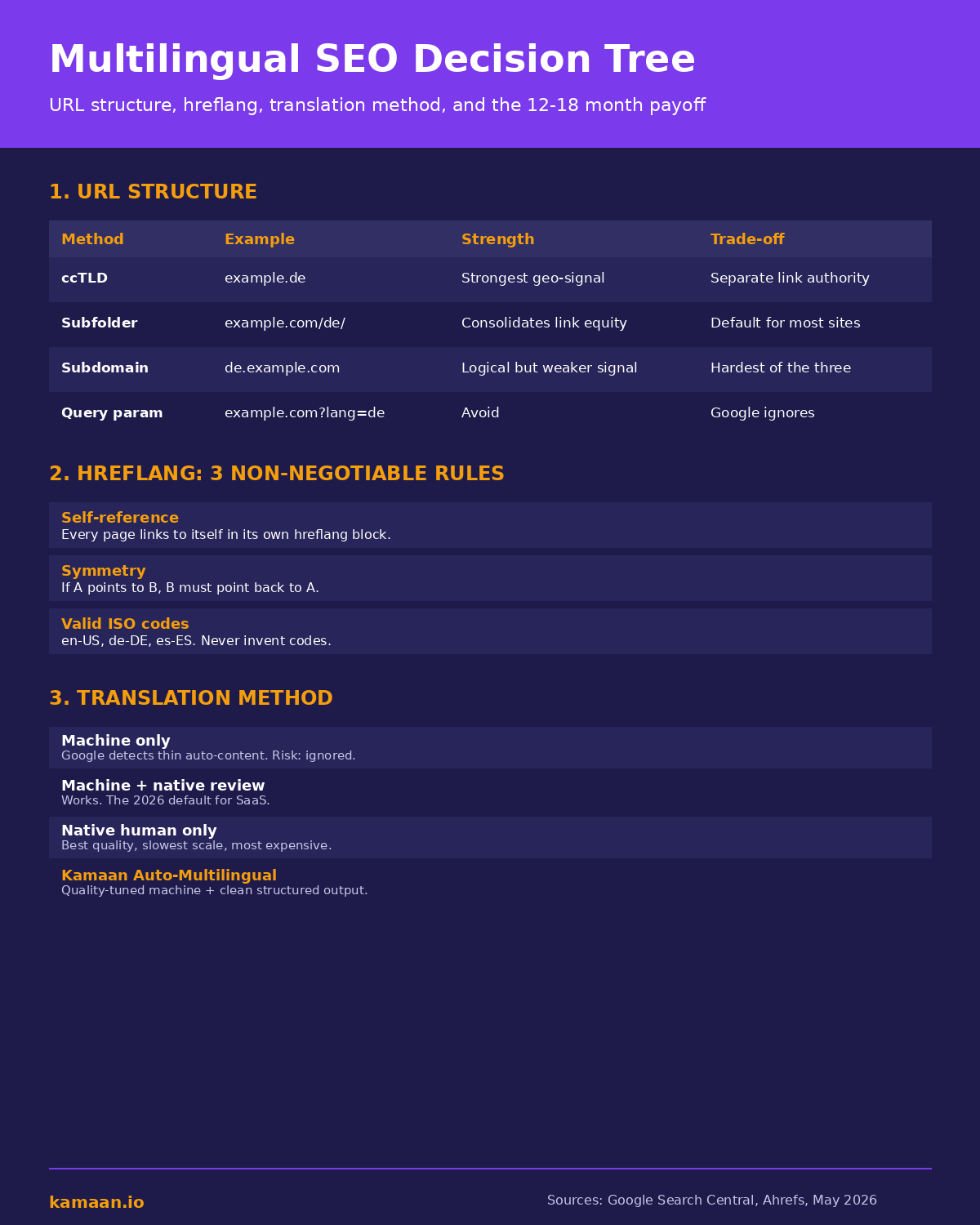
The three real options are subfolders, subdomains, and ccTLDs. There is a fourth option (query parameters like ?lang=de) but Google ignores it for geo-targeting purposes, so it is not a serious choice.
Subfolders. example.com/de/blog/. The default recommendation for most SaaS teams. All link authority consolidates under one domain, so when the English version of an article earns backlinks, the German version also benefits indirectly. One DNS record, one SSL certificate, one analytics property. Easy to set up, easy to maintain. The downside: the geo-signal is weaker than a ccTLD because the domain itself does not change.
Subdomains. de.example.com. Logically clean but Google treats subdomains as more separate from the root domain than subfolders, which means link equity does not consolidate as cleanly. Most international SEO authorities recommend against subdomains for blog content in 2026.
ccTLDs. example.de, example.fr. The strongest geo-targeting signal. If you tell Google your site is at example.de, it has no doubt the content is for German users. The cost: every ccTLD is a separate domain with its own link authority. Backlinks to example.com do not benefit example.de. For early-stage SaaS, this fragmentation is usually not worth the targeting strength. ccTLDs make sense for established companies with the budget to do dedicated SEO and link-building per market.
Pick subfolders unless you have a specific reason not to. Kamaan defaults to /<lang>/blog/<slug> (so /es/blog/, /de/blog/) which is the cleanest subfolder shape for a multilingual blog.
Hreflang: the technical layer 75% of sites break
Hreflang tells Google "this page is the English version, this page is the German version, this page is the French version, they are all translations of the same content." Without it, Google might serve your English page to a German user, or worse, treat the German and English pages as duplicate content and rank neither.
There are three non-negotiable rules. Get any one wrong and Google ignores the entire cluster:
1. Self-reference. Every page must include a hreflang tag pointing to itself, plus tags pointing to every translation. The English page lists itself plus all the translations. The German page lists itself plus all the translations including the English one. Same set, repeated on each page.
2. Symmetry. If page A links to page B as its German alternate, page B must link back to page A as its English alternate. Asymmetric links break the entire cluster.
3. Valid ISO codes. Use standard ISO 639-1 codes for language (en, de, es, fr, it) and ISO 3166-1 codes for region when needed (en-US, en-GB, es-ES, es-MX). Invented codes like "english" or "de-german" silently fail. Google's Search Central documentation has the full reference list.
Hreflang lives in one of three places: in the page <head>, in your XML sitemap, or in HTTP headers. Most SaaS teams use the <head> approach because it is easiest to debug, and you can produce the tags for a page with a free hreflang tag generator. Kamaan emits hreflang server-side in the rendered HTML so your team does not have to maintain it manually.
The 75 percent error rate comes from a 2024 Ahrefs study and remains roughly accurate today. The most common errors are missing self-references, asymmetric clusters when one language version is unpublished, and broken codes after a content team adds a new locale without updating the existing pages.
For the full implementation walkthrough on where hreflang can live (HTML head, XML sitemap, HTTP headers) and the five mistakes that kill rankings, read Hreflang Tags Explained: The Right Way to Set Them Up for a Blog.
Translation method: where most multilingual SEO actually dies
You can have perfect URL structure and perfect hreflang and still rank for nothing if the translated content is bad. Google detects thin auto-translated content. It will index it, refuse to rank it, and demote your overall site quality signal as collateral damage.
Four real translation approaches:
Machine only. DeepL Pro or Google Translate, copy, paste, publish. Risk: Google demotes the content as auto-generated. Result: indexed but not ranked. Use only for non-SEO-critical surfaces (internal docs, footer pages, status messages).
Machine plus native review. A native speaker reviews and edits the machine output before publish. The 2026 default for B2B SaaS. Costs a fraction of full human translation, ranks competitively. The native reviewer is the SEO-critical investment.
Native human only. A native-speaker translator writes from the source. Best quality, slowest, most expensive. Use for the highest-stakes pages (pricing, signup, top-funnel landing pages) where ranking matters most.
Kamaan's Auto-Multilingual Delivery. Quality-tuned machine translation with clean structured output, optimized specifically for ranking. Ships 99+ languages on every publish with hreflang and locale URLs handled server-side. For SaaS teams that need to scale across markets without hiring a translator per language, this is the lowest-friction option in 2026.
The honest tradeoff: machine-only is too thin for SEO; full human is too expensive at scale; machine + native review is the right answer for most teams; Auto-Multilingual Delivery is the right answer if you want to skip the native-review overhead and trust the model's output for blog content.
The 12 to 18 month payoff curve
Multilingual SEO is a long game. The realistic timeline:
- Months 1 to 3. Minimal traffic from new language markets. Google is indexing, evaluating, and weighing your site authority for new geographies. Patience matters.
- Months 3 to 9. Gradual growth. Long-tail queries start to rank. You see traffic from search queries you did not target directly.
- Months 9 to 18. Compounding growth. Established pages climb rankings, internal links between language versions strengthen the cluster, and your domain becomes a known entity in the new market.
- Months 18+. Meaningful ROI. The traffic and conversion numbers from new markets justify the original investment.
This curve is why most SaaS teams give up on international SEO at month 4 or 5. The investment looks like it is not paying off, so they pull back. The teams that win are the ones that hold the line for 12 months and let the compounding kick in.
Real-world scenarios
A bootstrapped SaaS founder ships an English-only B2B product with a 100-article blog. They turn on Kamaan's Auto-Multilingual Delivery for Spanish, German, French, and Italian. Within ten minutes, every existing article exists in all four languages with proper hreflang and /es/, /de/, /fr/, /it/ URLs. Google indexes the new pages over the following two weeks. Months 1 to 3 produce small traffic increases from long-tail queries. Months 9 to 12 produce a roughly 40 percent lift in total organic traffic from the new markets combined, with most growth in German and Spanish.
A Series A SaaS team operates a translated blog using WordPress + WPML. The hreflang is configured but breaks every time a writer adds a new locale to one article without updating the others. The team spends roughly 6 hours per month auditing and fixing hreflang errors. After switching to a headless CMS with server-side hreflang emission, that audit work disappears. The 6 hours per month gets reinvested in actual content production.
FAQ
What is the difference between multilingual SEO and international SEO?
Multilingual SEO focuses on language: making sure the right language version of a page ranks for the right query. International SEO is broader and includes regional targeting (country-specific content), currency handling, payment localization, and legal compliance. For a SaaS blog, multilingual SEO is the relevant 80 percent.
Do I need hreflang for every single page on my site?
You need hreflang for every page that has alternate-language versions. Pages that exist only in one language (a country-specific landing page, a region-specific legal page) do not need hreflang. The hreflang annotation lives on each page in the cluster and lists all members of that cluster.
Will Google penalize me for machine-translated content?
Google does not formally "penalize" auto-translated content; it demotes it as low quality, same practical effect: the page does not rank. The fix is machine translation followed by native-speaker editing, or a quality-tuned auto-translation system like Kamaan's Auto-Multilingual Delivery.
How long does it take to see results from multilingual SEO?
Plan for 12 to 18 months. The first 3 months produce minimal signal. Months 3 to 9 produce gradual growth on long-tail queries. The compounding payoff arrives in months 9 to 18 as your domain becomes recognized in each market.
Should I use subfolders or subdomains for multilingual content?
Subfolders. They consolidate link authority under one domain, signal language clearly to Google, and avoid the maintenance overhead of separate domain or subdomain configurations. The exception is ccTLDs (example.de) for established companies with the budget for dedicated per-market SEO and link-building.
What happens if I add a new language to my site?
Every existing page in the hreflang cluster needs an entry for the new language. Add German to an English/Spanish/French site and all three existing pages need new hreflang entries pointing at the German version. A headless CMS that auto-emits hreflang (Kamaan) handles this; manual setups require touching every page.
Can I rely on Google to translate my pages for users?
Chrome's built-in translation is a user-side feature, not an SEO signal. Chrome-translated pages do not rank for queries in the target language because they do not exist as indexable URLs. To rank in German, you need a German page at a German URL.
Related on Kamaan
-
How to Build a Multilingual Blog: A Complete Guide for SaaS Products. The end-to-end setup walkthrough for shipping a blog across languages.
-
What Is a Headless CMS: A Plain-English Guide for SaaS Teams. The architectural primer on why headless CMSes solve multilingual cleanly.
-
Headless CMS vs Traditional CMS: What SaaS Teams Actually Need. The architecture comparison, including why WordPress + WPML breaks at scale.
-
Headless CMS Benefits: What You Actually Get (and What You Give Up). The honest tradeoff guide for evaluating headless tools.
-
Blog URL Structure for Multiple Languages: Subfolders, Subdomains, or Query Params. The structured decision for URL pattern on a multilingual blog, with the narrow cases where subdomain or ccTLD actually wins.
Start building with Kamaan
Rank in every market, without the hreflang headaches.
Kamaan gives you one dashboard for all your product blogs, auto-translated into 99+ languages on every publish. Hreflang and locale URLs are emitted server-side. One account covers unlimited sites at a flat rate. First month free.