Most "companies using X CMS" articles are written by the CMS vendor. Logo wall, no engineering detail, no source. This article is the opposite: 7 real SaaS engineering teams, the headless CMS they actually run in production, and the public source where you can verify each pick.
Quick takeaways
- Five of the seven SaaS teams here run a managed cloud headless CMS (Contentful or Sanity). Two keep content as MDX or Markdown files in the same repo that ships their product.
- Every one uses Next.js, Gatsby, or another React-based frontend.
- Multilingual is almost always a custom build. Not one of the seven public case studies advertises an AI translation pipeline.
- No public case study yet describes publishing through an MCP client. The "command center" pattern is still being assembled by hand.
How we picked these 7
Three rules. Rule one: a real public source. Each company either publishes their content code openly on GitHub, has a documented case study, or has had an engineer talk about the stack on the record. No public source, no entry on the list.
Rule two: SaaS only. Retail, telecom, and consumer brands are excluded.
Rule three: variety of pattern. The 7 cover the two dominant architectures in production: managed cloud CMS (Contentful, Sanity) and Git-backed (MDX or Markdown in a repo).
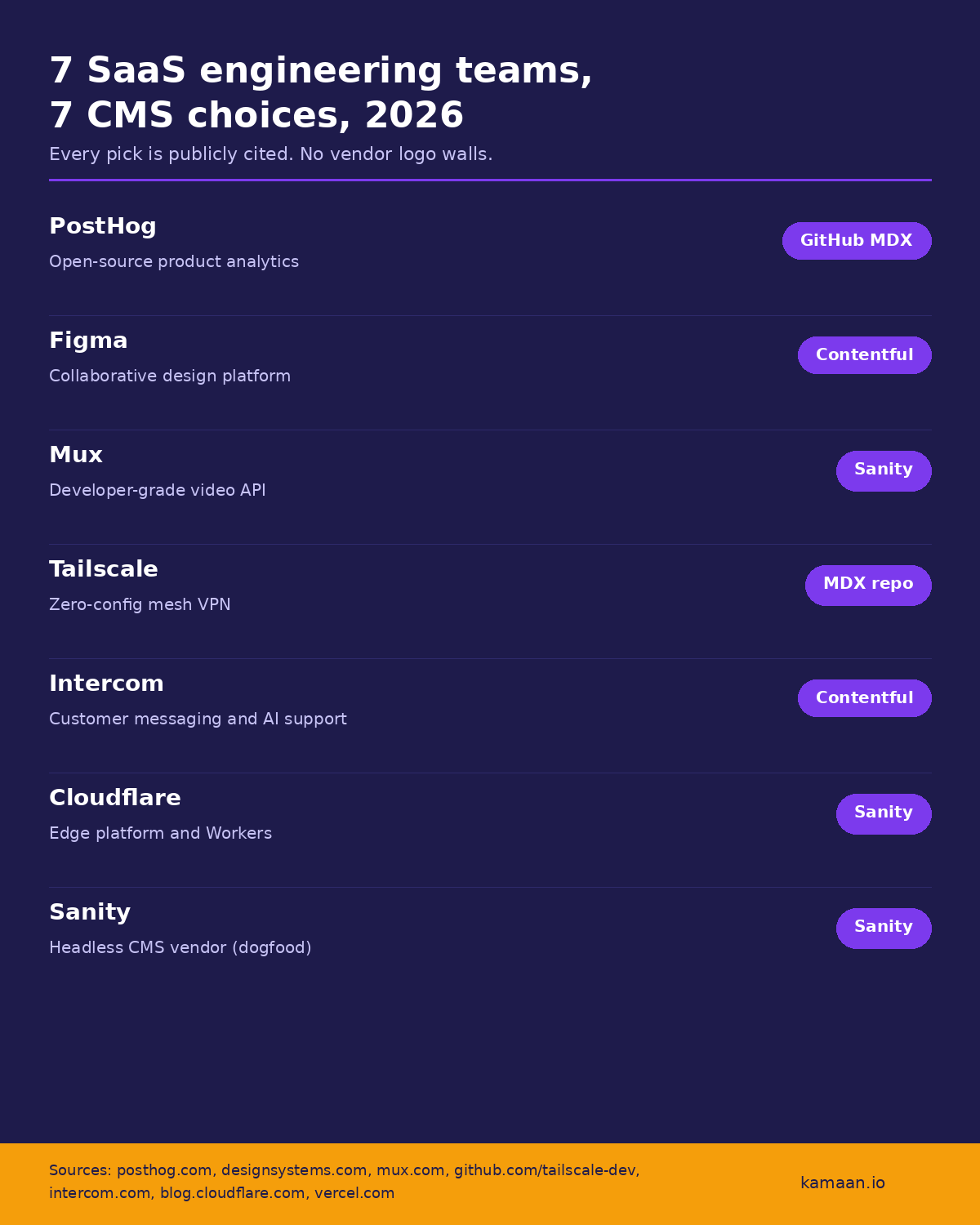
Here is the at-a-glance pick list for the article below.
The 7 examples
1. PostHog: GitHub as a CMS
PostHog is an open-source product analytics platform. Their marketing site, handbook, blog, and docs all live in one public GitHub repository, written in MDX. PostHog's engineering team wrote a long post titled "Why we use GitHub as our CMS" explaining the decision: transparency, an editorial workflow built on pull requests, and an engineering-first culture where the marketing team treats content like code.
About 40% of merged pull requests on the posthog.com repo come from people outside marketing, website, and docs. For community profiles and forum posts, PostHog uses Strapi. The main site is GitHub plus Gatsby plus MDX.
Source: Why we use GitHub as our CMS, posthog.com (March 2023).
2. Figma: Contentful for the marketing site
Figma is the collaborative design platform now owned by Adobe. Figma's marketing team published a detailed writeup of how they built the figma.com design system on Contentful, with a small cross-functional team of one producer, one developer, and one designer rebuilding the marketing site over a month. The result: figma.com goes from concept to ship in one day, without a developer touching the page.
Reusable components live in Contentful. When the team wants to change a typography token or a button style across the site, they update it once in Contentful, not page by page. The marketing team owns publishing end to end.
Source: How a small team built figma.com's design system, designsystems.com (a Figma publication).
3. Mux: Sanity for the blog and content
Mux is the video API used by streaming products, ed-tech tools, and AI video startups. The mux.com blog runs on Sanity. You can confirm this by opening any post on the Mux blog and inspecting the image URLs, which are served from cdn.sanity.io/images/2ejqxsnu/production/. Mux first announced the Sanity relationship in 2018 with a joint integration: a Mux plugin inside Sanity Studio that lets editors upload video directly to Mux without leaving the CMS.
Source: Mux + Sanity = Responsive video in headless CMS, mux.com blog.
4. Tailscale: MDX plus ContentLayer in an open repo
Tailscale ships a zero-config mesh VPN built on WireGuard. Their developer-facing community site tailscale.dev is fully open source. The repository README spells out the stack: Next.js for the frontend, Tailwind CSS for styling, and ContentLayer to process MDX content. Blog posts and events are stored as .mdx files under /data/blog and /data/events. Authors are also defined as MDX with front matter.
This is the same architectural pattern PostHog uses, with a different toolchain. Content as code, pull requests as the editorial workflow, every change versioned in git.
Source: tailscale-dev/tailscale-dev on GitHub.
5. Intercom: Contentful behind a Next.js front
Intercom rebuilt intercom.com in 2019 on Contentful, with tech lead Steven Petryk publishing the architecture writeup on the Intercom blog. The site is a server-side-rendered Next.js application that pulls all content from Contentful. The team generates TypeScript interfaces from the Contentful schema, so a content change that breaks the contract with the frontend fails to compile rather than shipping a broken page.
Deploy time dropped from 20 minutes to about 90 seconds.
Source: Rebuilding Intercom's homepage with a new CMS, intercom.com blog (June 2019).
6. Cloudflare: Sanity plus Gatsby on Workers
Cloudflare built a public showcase site called "Built with Workers" to highlight sites running on Cloudflare Workers. The showcase itself is built on Sanity for content, Gatsby for the frontend, and Workers for deployment. Cloudflare's engineering team published "JAMstack at the Edge" describing how the site was wired together, and Sanity published a companion case study from their side.
Sanity covers the marketing-friendly structured content, Gatsby gives the team a fast static frontend, and deploying on Workers proves the product the showcase is selling.
Source: JAMstack at the Edge: How we built Built with Workers on Workers, blog.cloudflare.com.
7. Sanity: Sanity plus Next.js on Vercel (dogfood)
Sanity itself runs sanity.io on Sanity content lake, with a Next.js frontend on Vercel. Vercel published a case study on the rebuild, including Sanity's use of Vercel Edge Middleware for experiment routing. The earlier site was a custom React framework on Docker and GCP, retired in 2018 in favour of Next.js. Dogfood case: a CMS vendor running their own marketing site on their own product.
Source: Sanity balances experimentation and performance with Vercel Edge Middleware, vercel.com blog.
The pattern matrix below shows all 7 picks side by side, with the public source for each.
Patterns across the 7 examples
Four patterns emerge across the seven.
Pattern one. Managed cloud CMS wins when the marketing team owns publishing. Figma, Intercom, Mux, Cloudflare, and Sanity all picked a managed cloud headless CMS. The common thread is a marketing team large enough that pull requests would be a bottleneck, plus a content model complex enough to need a structured schema.
Pattern two. Git-backed wins when writers are engineers. PostHog and Tailscale are the exceptions. Both are developer-focused companies where the marketing team is small, writers are engineers, and embedded product components in content matter more than a visual editor.
Pattern three. React-based frontends are universal. Every one of the seven runs a React-based frontend. Next.js shows up most often, Gatsby twice. The mature SDKs across Sanity and Contentful are on Next.js first, and new SaaS companies copy the dominant stack.
Pattern four. Multilingual and AI publishing are not yet first-class. Not one of the seven public case studies leads with "we translate into N languages automatically" or "we publish from an AI agent." If you need multilingual or AI publishing as a first-class workflow today, you will be building it yourself on top of the CMS.
What a new founder building today would do differently
The seven companies above made their CMS calls between 2018 and 2023, when the choice was "managed cloud CMS or Git-backed MDX" and both were fine answers for one site. The variable that has changed is the number of sites a founder is expected to run. A modern SaaS founder often runs the main product blog, a secondary product blog, a personal blog, plus a microsite or two. None of the seven stacks above scale cleanly to that. Each new site is a new Sanity dataset, a new Contentful space, a new repo, a new editor login, a new bill.
This is the gap Kamaan is built around. Kamaan is the command center for multi-product founders and agencies who run many SaaS blogs: manage every blog from one dashboard, and run every operation across all of them from Claude, ChatGPT, Cursor, or any MCP client. Billing is one flat monthly rate for unlimited sites, with no per-site, per-space, or per-seat fees. The first month is free, no credit card, cancel anytime. A lifetime plan is available. Translation is built in and auto-delivered on publish.
Honest framing: if you are Intercom or Figma, your CMS is already in production. Kamaan is not "better than Contentful for Intercom." Kamaan is the answer if you are choosing today, you run two or more sites, and you do not want to assemble the same multilingual plus AI publishing layer by hand.
Scenario: a founder picking today
A founder runs a developer-tools SaaS, ships a docs-first marketing site, and plans to launch a second product in nine months. Team: founder, two engineers, one part-time writer. The founder needs content shipping this quarter, Spanish and German coverage before launch, and one place to run both products from when product two ships.
Picking Sanity or Contentful per product gets the founder to "good enough" on site one but doubles the bill on site two. MDX-in-repo gets the docs out fast but blocks the part-time writer from publishing without a pull request. Kamaan covers both products from day one: same dashboard, same editor login, same translation pipeline, with publishing driven from Claude or Cursor across both sites. Time from signup to first published post is around 14 minutes.
FAQ
Which headless CMS is most popular among SaaS companies?
Contentful and Sanity are the most-cited managed cloud picks across these 7 plus a broader scan of public case studies. Git-backed MDX dominates at developer-tools companies where writers are engineers.
Is Git-backed Markdown a "real" CMS?
For developer-tools companies, yes. PostHog and Tailscale treat their public GitHub repository as the content backend, with pull requests as the editorial workflow. Tradeoff: non-technical writers cannot publish without learning git.
Why do so many SaaS companies use Next.js with their CMS?
Next.js has the most mature SDKs across Contentful and Sanity, and Vercel has built first-party integrations with the major headless CMS players. New SaaS companies copy the dominant stack.
What does Figma use for their marketing site?
Contentful. The architecture is documented on designsystems.com (a Figma publication), and the marketing team ships pages from concept to live in one day without engineering involvement.
Do any of these companies use AI to translate or publish content?
Not in their public case studies. Every one of the seven treats translation and editorial workflow as a custom build on top of the CMS.
What is the closest answer for a founder running multiple SaaS blogs?
For someone choosing today and running two or more sites, Kamaan handles unlimited sites under one dashboard and one flat monthly bill, with multilingual and AI publishing built in.
How fast can a founder get the first post live on a new site?
For Kamaan the typical "signup to first published post" is around 14 minutes. For Sanity or Contentful, schema setup and Next.js integration usually runs into a half-day, even with a starter template.
Related on Kamaan
- What is a headless CMS covers the architecture pattern that all 7 of these companies use.
- Best headless CMS for startups helps you pick between the options if you are starting today.
- Headless CMS with Next.js walks through the frontend stack every one of the 7 examples runs.
- Contentful alternatives is the comparison most teams reach for when their CMS bill grows.
Start building with Kamaan
Kamaan is the command center for founders and agencies running many SaaS blogs. Manage every blog from one dashboard, and run every operation across all of them from Claude, ChatGPT, Cursor, or any MCP client. One flat monthly bill for unlimited sites, no per-site, per-space, or per-seat fees. First month free, no credit card, cancel anytime. A lifetime plan is available. Translation credits are only consumed when Kamaan does the translation. Bring your own translated copy and it costs nothing. Most new accounts get their first post live in around 14 minutes. Start at kamaan.io.