A founder running three SaaS products picks Ghost because it is clean, opinionated, and ships fast. Six months later, the German prospect asks if there is a German version of the blog, and the founder discovers Ghost runs one language per install. The honest fix is three Ghost installs per product, nine total, each with its own theme, members system, and update cycle. That is not a content problem. That is an operations problem Ghost was never designed to solve.
Quick takeaways
- Ghost has no native multilingual blog support. The official docs recommend one install per language, or a third-party translation service like Weglot.
- Kamaan ships Auto-Multilingual Delivery on the Growth tier and up: publish in English, the Spanish, German, French, and Italian versions go live automatically at /es/blog, /de/blog, /fr/blog, /it/blog with correct hreflang.
- For a 3-product founder, Ghost means up to 9 installs to run; Kamaan's Growth tier covers three sites with three languages each, operated from one dashboard.
- Ghost is built around members and subscriptions. Kamaan is built around running many blogs from one place, driven by Claude, ChatGPT, Cursor, or any MCP client.
- Hreflang is theme-level work on Ghost. Kamaan emits it server-side.
What Ghost is, and where multilingual stops
Ghost is a focused publishing platform with a strong opinion about what a publisher needs: a clean writing experience, native members, paid subscriptions, an email layer, and a Handlebars theme system. For a single-language newsletter or independent magazine, Ghost is one of the best tools you can pick. The opinion stops being helpful the moment a publisher needs to serve more than one language from the same content database.
Ghost's own documentation is direct about this. The recommended approaches are: run one Ghost install per language, or use a third-party translation service that intercepts the rendered HTML. There is no field-level localization, no native hreflang management at the content layer, and no way to publish an article in English and have a Spanish version appear at a localized URL on the same install. The theme system supports translated UI strings (button labels, dates, system text), which is useful but does not solve the actual blog-content problem.
This is not an accident or a roadmap item. Ghost has been clear for years that multilingual content is out of scope for the core product. The community has built workarounds: subdirectory routing tricks, parallel installs with shared themes, Weglot or Crowdin integrations. Every one of those workarounds adds an operations layer the founder did not have before.
What Kamaan does on publish
Kamaan is a headless blog CMS for SaaS founders and agencies. The Auto-Multilingual Delivery feature is built into Growth (3 sites, 3 languages), Scale (10 sites, 10 languages), and Unlimited (up to 25 sites, 99+ languages). Starter covers one site and one language; if a founder needs multilingual, Growth is the entry tier.
The mechanic is the part Ghost cannot match. You write an article in English, click publish, and the equivalent versions in the languages on your plan are auto-delivered. Each lives at its own localized URL on the same domain: /es/blog, /de/blog, /fr/blog, /it/blog. Hreflang tags are emitted server-side, so Google sees the correct language relationship without any theme code. The /es and /de versions link to the original English versions through rel="alternate" declarations, and the English version links back. The founder does not write a single line of code to make that work.
Translation can run through Kamaan's built-in pipeline (consumes AI credits on the tier), or via BYOK if the founder prefers to run translations through their own Claude or ChatGPT account. Both paths produce the same end state: a localized version at the right URL with the right metadata, and if you want to check how each version's social preview renders before sharing, a free Open Graph generator makes it easy to build and validate those tags.
The honest comparison
The chart below maps Ghost's actual capabilities against Kamaan's, dimension by dimension. Both products are good at what they were built for; the question is which problem the founder is actually solving.
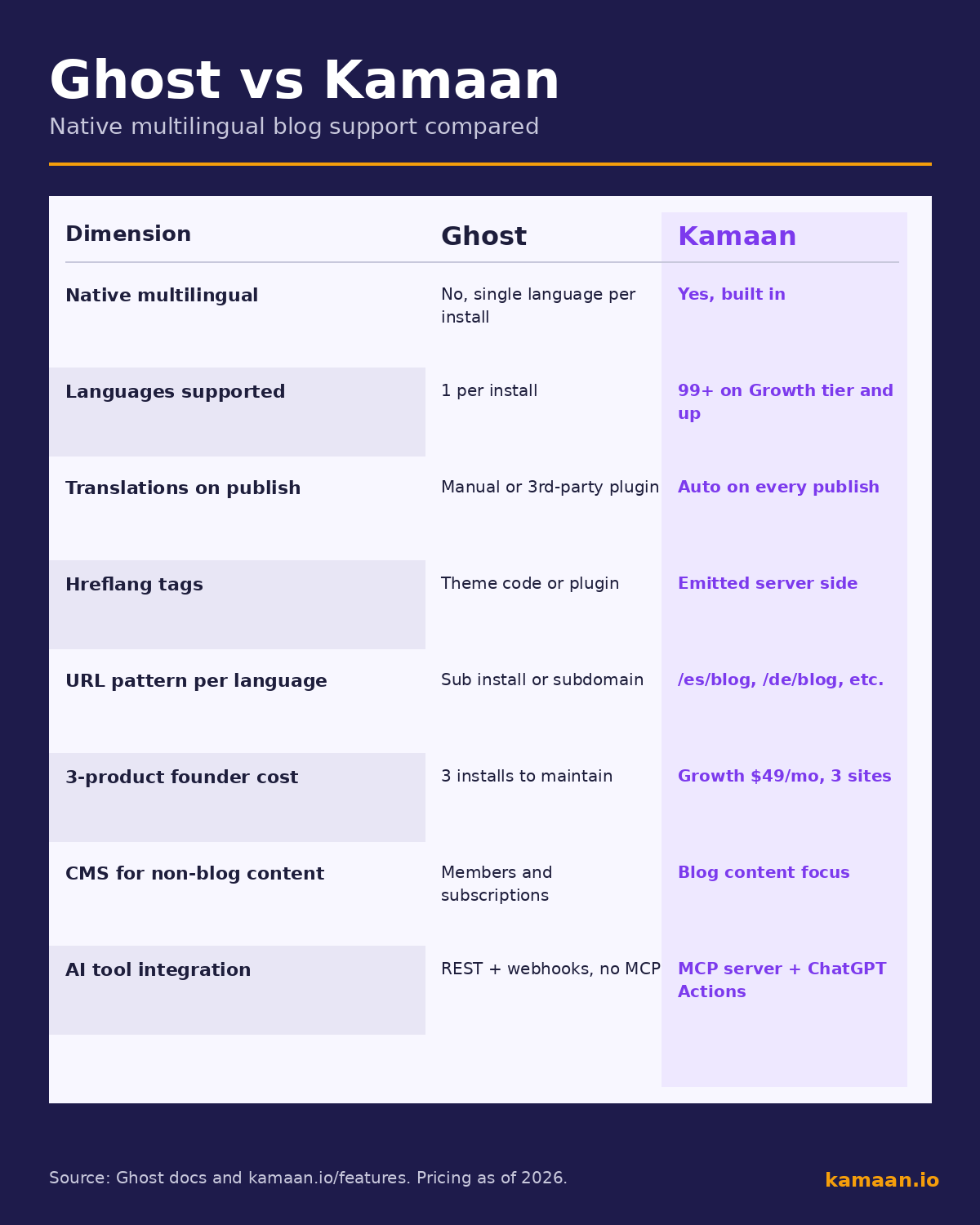
| Dimension | Ghost | Kamaan |
|---|---|---|
| Native multilingual blog | No, single language per install | Yes, built in (Growth tier and up) |
| Languages on publish | 1 per install | 99+ on Unlimited, 10 on Scale, 3 on Growth |
| Translations workflow | Manual paste or third-party plugin (Weglot, Crowdin) | Auto-delivered on every publish |
| Hreflang tags | Theme code or plugin | Emitted server side |
| URL pattern per language | Sub install or subdomain | /es/blog, /de/blog on same domain |
| 3-product founder setup | 3 installs to maintain (or 9 with 3 languages each) | Growth covers 3 sites |
| AI tool publishing | REST API and webhooks, no MCP | MCP server, ChatGPT Actions, Cursor support |
| CMS focus | Members, subscriptions, email | Blog content across many sites |
The pattern is consistent. Ghost is the right pick when the goal is to run one publication in one language with paid subscribers. Kamaan is the right pick when the goal is to run several blogs in several languages without hand-rolling the translation pipeline or the hreflang implementation.
Where Ghost still wins
Ghost owns categories Kamaan does not compete in. If the product is a paid newsletter, Ghost has native members, Stripe billing, magic-link signup, and an email-sending pipeline ready to go. If the product is a single-language independent publication that needs a polished public-facing site with built-in subscription mechanics, Ghost is hard to beat.
Ghost also has years of theme work. Casper, Edition, Source, and dozens of community themes ship a launch-ready front end without custom development. Kamaan is headless: the front end is whatever framework the founder uses (Next.js, Nuxt, SvelteKit, Astro). For a team that does not want to think about rendering, Ghost is the simpler shape.
The honest filter: pick Ghost for paid newsletter-style publications. Pick Kamaan for SaaS product blogs that need to run in multiple languages and live alongside the rest of a product portfolio.
The cost math at 3 products
A multi-product founder running three SaaS products, each with a blog in English, Spanish, and German, has two architectural choices.
On Ghost, the recommended setup is one install per language per product. Three products, three languages each, is nine installs. Even at the Creator tier ($25 a month per install at low traffic), that is $225 a month plus hosting if self-managed, plus nine themes to keep in sync, plus nine member systems no one is using, plus nine update cycles. The setup is technically possible. It is operationally expensive.
On Kamaan Growth, the same founder gets three sites and three languages each from one account. One dashboard for content, one billing line, one place to look. Publishing an article on Product A's blog auto-delivers the Spanish and German versions to that product's localized URLs. The same login switches over to Product B's blog and works identically.
The cost ratio is roughly 5x in Kamaan's favor at three products with three languages each, and the gap widens fast: at 10 products with 10 languages each, the Ghost setup is 100 installs, and Kamaan's Scale tier covers it from one account.
How founders actually use Kamaan
A bootstrapped founder running three B2B SaaS tools publishes blog updates for all three from a single Kamaan dashboard. They open the Growth-tier account, switch to Product A, draft a release-notes post, hit publish, and the Spanish and German versions land at /es/blog and /de/blog within minutes. Same login, switch to Product B, ship a feature announcement, same three-language outcome. Same login, Product C. One billing line at the end of the month.
A founder pairing Kamaan with Claude opens a Claude conversation, drafts the article inline, and uses Kamaan's MCP server to publish directly without opening a browser tab. The article goes live in English, the auto-translations follow on the same publish event, and the founder closes the laptop without having touched the dashboard.
When the switch from Ghost actually makes sense
Switching CMS tools is expensive. The article URLs change, the internal linking is broken, the RSS subscribers lose their thread, and the migration tooling is almost always a custom script. So the question is not "is Kamaan better than Ghost in general," it is "is the multilingual gap costing more than the migration would."
The honest trigger points are: the founder is already maintaining more than one Ghost install for language reasons, the founder is paying for a Weglot subscription that costs more than $49 a month, or the founder is about to add a second product and would be standing up a second Ghost from scratch. In any of those cases, the switch math starts to favor Kamaan.
If the founder is running a single English publication and adding a German version is a "maybe next year" item, stay on Ghost and revisit when the question becomes concrete.
FAQ
Does Ghost CMS support multiple languages natively?
No. Ghost is designed to run one language per install. The official recommendation is to run one Ghost install per language, or to use a third-party translation service like Weglot. The theme system supports translated UI strings (dates, button labels), but there is no native field-level content localization.
How does Kamaan handle multilingual publishing?
Kamaan's Auto-Multilingual Delivery publishes the localized versions of every article the moment you hit publish in English. Each version gets its own URL (/es/blog/slug, /de/blog/slug, etc.) and hreflang tags are emitted server-side. Growth tier covers 3 languages, Scale covers 10, Unlimited covers 99+.
Can I migrate from Ghost to Kamaan?
Yes. Kamaan accepts content imports from any source via its REST API. The typical migration is a script that reads Ghost's export JSON and writes each post into Kamaan with the right metadata. URL preservation depends on your front-end framework; Kamaan does not own the URL structure on your domain.
What does it actually cost to run three Ghost installs versus Kamaan Growth?
Three Ghost installs at the Creator tier (around $25 a month each) is roughly $75 a month plus three theme syncs and three update cycles. Kamaan Growth covers 3 sites and 3 languages each from one dashboard. First month free.
Does Ghost have an MCP server for Claude or ChatGPT?
No. Ghost exposes a Content API and an Admin API, both REST. There is no native MCP server, and the official integration story is webhooks plus the Admin API. Kamaan ships an MCP server out of the box for Claude, Cursor, and any MCP client, plus ChatGPT Actions for ChatGPT.
Is hreflang a problem on Ghost?
It depends on the theme. Ghost's Handlebars theme system lets you add hreflang tags manually, but you have to maintain the relationships across all your installs yourself. Most Ghost multilingual setups end up with broken or partial hreflang because no one wants to own that bug at the theme layer. Kamaan emits it server-side, which removes the failure mode.
Can I use Ghost and Kamaan together?
You can. If the main product is a paid newsletter, run that on Ghost. If you also need a multilingual product blog for a separate SaaS, run that on Kamaan. The two do not share content.
What is the cheapest way to get a multilingual blog on Kamaan?
Growth is the entry point for multilingual on Kamaan. Starter covers one site and one language and does not include auto-translate or hreflang. If you only need one blog with one language, Starter is fine. If you need any multilingual, Growth is the right tier. First month free on both.
Related on Kamaan
- Best Headless CMS for Startups: An Honest Comparison With Pricing. The full pillar comparing Kamaan to Contentful, Sanity, Storyblok, Ghost, and Strapi on eight dimensions.
- How to Build a Multilingual Blog: A Complete Guide for SaaS Products. The multilingual SEO pillar covering URL structure, hreflang, and auto-translation tradeoffs.
- Auto-Translate Blog Posts: What Works, What Breaks, and What Kamaan Does Instead. Why DeepL + manual paste, Weglot, and Crowdin break at scale, and what to use instead.
- Contentful Alternatives: 6 Headless CMS Tools That Are Not $300 Per Month. Five other tools in the same space, with honest pricing math at each tier.
- Multi-Site CMS: One Account, Multiple Domains, Without the Cost of Contentful. How Kamaan's Multi-Site Management replaces a per-space billing model.
Start building with Kamaan
Three product blogs, three languages each, one dashboard
Kamaan gives you one place to run every SaaS blog you operate, auto-translated into the languages on your plan and driven from Claude, ChatGPT, Cursor, or any MCP client. Growth covers three sites and three languages each. First month free.