Someone on your team says "we should translate the blog into German," and someone else says "no, we need to localize it," and nobody in the room can explain the difference in one sentence. It matters more than it sounds. Pick "translate" when the job actually needs localization and your German traffic never arrives. Pick "localize" for content that only needs a clean translation and you burn budget you did not have to spend. The distinction decides how much a market costs you and whether the content ever ranks there.
Quick takeaways
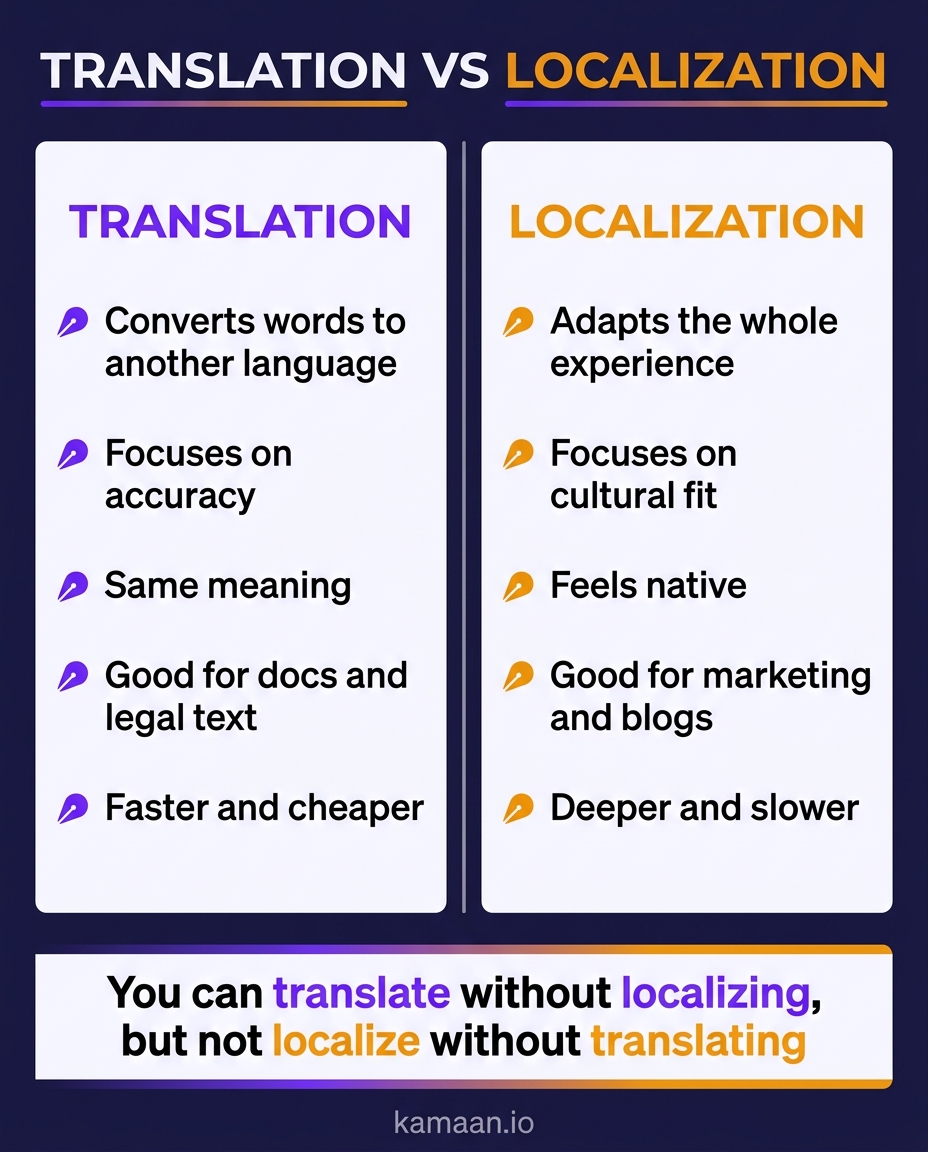
- Translation converts words from one language to another and focuses on accuracy. Localization adapts the entire experience, culture, formats, and search behavior, so it feels native.
- You can translate without localizing, but you cannot localize without first translating. Translation is a step inside localization, not a separate choice.
- Use translation for docs, legal text, and internal content. Use localization for marketing, landing pages, and blog posts meant to rank and convert.
- Machine translation gets you 80 percent of the way for free. The last 20 percent, the cultural and SEO layer, is what separates traffic from silence.
- Kamaan's Auto-Multilingual Delivery handles the mechanical part of both, per-locale URLs and server-side hreflang, so your team spends its time on the human layer.
The one-sentence difference
Translation moves the words. Localization adapts the experience.
Translation is the process of converting text from a source language into a target language, with the goal of accuracy: the German reader gets the same meaning the English reader got. Localization is the broader process of adapting a product or piece of content to a specific market. It includes translation, then goes further, adjusting culture, tone, examples, currency, dates, units, imagery, and the search terms local users actually type.
The clean way to remember it: you can translate without localizing, but you cannot localize without translating. Translation is one layer inside localization, not an alternative to it.
Translation vs localization at a glance
| Translation | Localization | |
|---|---|---|
| What it changes | The words | The whole experience |
| Main goal | Accuracy, same meaning | Cultural fit, feels native |
| Covers | Language only | Language, culture, formats, imagery, SEO |
| Dates, currency, units | Left as-is | Adapted to the market |
| Local keywords and meta | Usually a literal translation | Researched and rewritten per market |
| Best for | Docs, legal text, technical content | Marketing, landing pages, blog posts |
| Effort and cost | Lower | Higher, but higher return where it matters |
| Risk if you pick wrong | Reads as foreign, ranks poorly | Overspend on content that only needed translation |
A worked example so the difference sticks
Take one line from a SaaS pricing article: "Start free, then pay $29 a month, billed every April." Watch what each process does with it.
Translation gives a French reader that exact sentence in French: "$29 a month" stays in dollars, "April" stays as an arbitrary month, and the phrasing is a literal carry-over. It is accurate and it is understood. It also quietly signals "written for someone else."
Localization rewrites it for France: euros instead of dollars, the billing framing adjusted to how French SaaS buyers expect to see it, and the surrounding copy tuned so it reads like a French company wrote it. It also swaps the meta title and description to target the French keyword a buyer would actually search, not the translated English one.
Both are "in French." Only one was built for a French reader.
When translation is enough
Localization is not always the right call. Sometimes translation alone is exactly right, and reaching for full localization is a waste.
Use translation when accuracy is the whole job and cultural resonance is beside the point:
- Technical documentation and API references, where a term must mean one precise thing.
- Legal text, terms of service, and compliance content, where fidelity to the source matters more than local flavor.
- Internal content: help-desk macros, internal wikis, knowledge bases for a global team.
- Anything where the reader needs to understand, not be persuaded.
For these, a good translation, human or machine with a review pass, does the job. Localizing them adds cost without adding value.
When localization is worth it
Reach for full localization when the content has to persuade, rank, or represent your brand in a market:
- Marketing pages, landing pages, and campaign copy, where tone and cultural fit drive conversion.
- Blog posts meant to rank in a local search engine, where the keyword and the on-page SEO must be local, not translated.
- Anything customer-facing that carries your brand voice, where "feels native" is the difference between trust and a bounce.
Blog content sits squarely in this bucket, which is why "we translated the blog and nothing happened" is such a common complaint. A blog that is translated but not localized usually targets the wrong keywords and reads slightly foreign, so it neither ranks nor converts.
The graphic below lays the two side by side so you can decide at a glance which one a given piece of content needs.
Where internationalization fits in
There is a third word that shows up in this conversation: internationalization, often shortened to "i18n." It is not the same as either translation or localization, and mixing them up causes real engineering pain.
Internationalization is the up-front technical work that makes localization possible: building your product and content so they can support multiple languages, character sets, date formats, and per-locale URLs without a rewrite. Localization is what you do afterward, market by market, on top of that foundation. In plain terms: internationalization is the plumbing, localization is the water. For a blog specifically, the "plumbing" is your CMS being able to store, deliver, and correctly wire up per-language versions with hreflang. If the CMS cannot do that, no amount of good localization will render correctly.
What this means for a multilingual blog
For a blog, the practical takeaway is a two-part split.
The human layer, the actual translation quality and the cultural adaptation, is where your team, or a good model with review, should spend its time. This is the part that decides whether the content resonates.
The mechanical layer, the per-locale URLs and the hreflang tags that connect language versions, is pure engineering, and it is where hand-run multilingual blogs fall apart. It does not need creativity; it needs to be correct every single time, across every post and every language.
Kamaan is a headless blog CMS that takes the mechanical layer off your plate. You publish once in English, and Auto-Multilingual Delivery publishes a version in every language on your plan, each at its own URL, with the hreflang emitted correctly server-side. You can bring your own translations, from a human editor or an LLM, so the human layer stays under your control, while the wiring you would otherwise get wrong is handled for you. Because it is one account and one dashboard for every blog you run, this holds whether you have one product or ten, and if you would rather run the whole flow from Claude or ChatGPT, the same publishing works through the Kamaan MCP Server and ChatGPT Actions. Our guide to what content localization involves at blog scale walks the five layers in order.
Translation gets your content understood. Localization gets it chosen. A CMS should make sure the correct version is the one Google shows.
FAQ
What is the difference between localization and translation?
Translation converts text from one language to another and focuses on accuracy. Localization is the broader process of adapting content to a market, including translation plus cultural adaptation, format changes (currency, dates, units), and localized SEO. Translation changes the words; localization adapts the whole experience.
Is localization just translation?
No. Translation is one step inside localization. Localization also adjusts tone, examples, imagery, formats, and the local keywords a page targets. A piece can be translated but not localized, and that is usually why a translated blog fails to rank in its target market.
Do I need both translation and localization?
You always need translation, because you cannot localize without first translating. Whether you also need the full localization layer depends on the content: docs and legal text often need only translation, while marketing and blog content need localization to perform.
What is the difference between localization and internationalization?
Internationalization (i18n) is the technical groundwork that makes a product or blog capable of supporting many languages, character sets, and per-locale URLs. Localization (l10n) is the market-by-market adaptation you do on that foundation. Internationalization is the plumbing; localization is the water.
What is the difference between a translator and a localization specialist?
A translator converts text accurately from one language to another. A localization specialist owns the wider job: they translate, then adapt culture, tone, formats, and imagery, and they coordinate the technical side (per-locale URLs, hreflang) so the content performs in its market. The translator handles the words; the localization specialist handles the whole market fit.
When should I translate instead of localize?
Translate when accuracy is the whole goal and cultural resonance does not matter: technical documentation, legal and compliance text, and internal content. Localize when the content has to persuade, rank, or carry your brand voice, like landing pages and blog posts.
Which is more expensive, translation or localization?
Localization costs more because it does more: cultural adaptation, format changes, and local keyword research on top of the translation. The higher cost is justified only where those extra layers add value, which is why prioritizing localization for your highest-traffic pages beats localizing everything.
How does a headless CMS handle translation and localization?
A multilingual-first headless CMS handles the mechanical part of both: it stores each language version, publishes it at its own URL, and emits the correct hreflang. Kamaan's Auto-Multilingual Delivery does this on publish, so your team focuses on translation quality and cultural fit instead of the wiring.
Related on Kamaan
- How to Build a Multilingual Blog: A Complete Guide for SaaS Products
- Auto-Translate Blog Posts: What Works, What Breaks, and What Kamaan Does Instead
- Multilingual SEO: What It Is, Why It Matters, and How to Get It Right
- Hreflang Tags Explained: The Right Way to Set Them Up for a Blog
Start building with Kamaan
Publish once, go live in 99+ languages
Kamaan is a headless blog CMS that handles the mechanical side of localization for you: per-locale URLs and server-side hreflang, automatically on publish. The Growth tier covers three product blogs with auto-translate into 99+ languages, and you can bring your own translations if you want full control of the human layer. First month free.