Most SaaS blogs are a graveyard of "5 tips for productivity" posts that nobody searches for and nobody buys from. You publish, traffic stays flat, and after three months you quietly stop. The problem is not that SEO does not work for software. It is that generic blogging is not SEO for SaaS. Real SaaS SEO maps every keyword to a stage in the buyer journey, uses your product as the proof, and treats the blog as a pipeline, not a hobby. This guide shows you how to build that engine, and how to publish it without drowning in tooling.
Quick takeaways
- SEO for SaaS is different from blogging: you target buyer-journey keywords (problem, solution, comparison) that lead to a signup, not vanity traffic.
- Split your keywords into three buckets: top of funnel (problem-aware), middle of funnel (solution-aware), and bottom of funnel (ready to buy). Each needs a different page.
- The highest-converting SaaS pages are product-led: comparisons, "alternatives" pages, and use-case content where your product is the answer, not a footnote.
- SEO in 2026 means ranking in Google and in AI answer engines (ChatGPT, Perplexity, Gemini) at the same time. Clean HTML, schema, and entity consistency serve both.
- Distribution is the bottleneck most founders hit: publishing consistently, in multiple languages, across every product you run. That is a systems problem, not a writing problem.
Why SEO for SaaS is not the same as blogging
A lifestyle blog wins by getting a lot of people to read a lot of pages. A SaaS blog wins by getting the right person to book a demo or start a free trial. Those are different games with different scoreboards.
Generic advice tells you to "post consistently and provide value." That produces traffic with no intent behind it. Someone reading "10 ways to stay motivated at work" is not evaluating software. SEO for SaaS starts one layer deeper: what does a person type into Google in the days and weeks before they pay for a tool like yours? Those queries are specific, lower in volume, and far more valuable. "How to track billable hours for a small agency" is worth more to a time-tracking SaaS than a viral post about the four-day week, because the searcher has the exact problem your product solves.
The second difference is that your product is allowed to be the answer. A media site has to stay neutral. You do not. The whole point of a SaaS blog is to show, in context, how the software removes the pain the reader arrived with. Done clumsily that reads like an ad. Done well it reads like the most useful page on the topic, one that happens to end with a working solution.
If you want the ground-level foundation for how a modern content stack is built, the plain-English guide to what a headless CMS is sets up terms this guide leans on.
Map keywords to the buyer journey
Every SaaS SEO strategy that works is built on the same spine: sort your keywords by how close the searcher is to buying, then build a distinct page type for each stage.
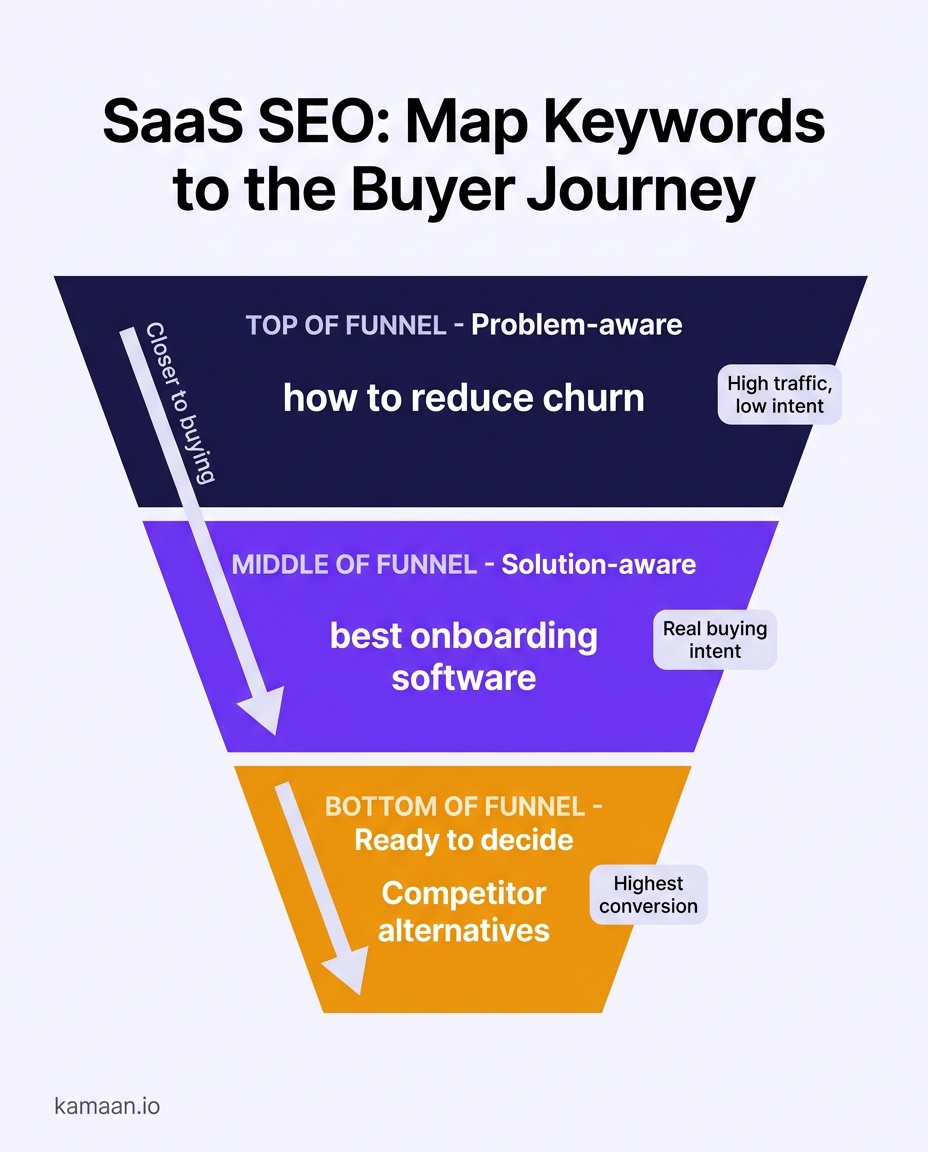
Top of the funnel (TOFU): problem-aware. The reader knows they have a problem but has not thought about tools yet. Queries look like "how to reduce customer churn" or "how to onboard new employees remotely." These earn trust and traffic. They rarely convert on the first visit, and that is fine. Their job is to get you into the consideration set.
Middle of the funnel (MOFU): solution-aware. Now the reader knows a category of tool exists. Queries look like "best onboarding software for startups" or "employee scheduling tools compared." These are listicles, category pages, and buyer's guides. Conversion intent is real here, and this is where most SaaS companies under-invest.
Bottom of the funnel (BOFU): ready to decide. The reader is comparing named options. Queries look like "[Competitor] alternatives" or "[Your Brand] vs [Competitor]." These pages are short-volume and high-value: someone searching them has a credit card nearby. A single strong "alternatives" page can outperform fifty TOFU posts on revenue.
The mistake is spending 90% of your effort on TOFU because it produces the biggest traffic number. The money sits in MOFU and BOFU, where intent is highest. Build there first, then widen the top of the funnel to feed it.
The funnel below shows how the three keyword stages line up against buying intent.
Build product-led content, not generic posts
The single biggest lever in SEO for SaaS is product-led content: pages where your software is woven into the answer rather than bolted onto the end.
Take a keyword like "how to send transactional email from your app." A generic post explains SMTP and stops. A product-led post explains SMTP, walks through the exact setup, shows the code, and demonstrates it working inside your product, with a real screenshot and a real result. The reader gets a complete answer and sees your tool solve the problem in the same scroll. That is the format that converts, and it is the format AI answer engines love to cite because it is concrete.
Three product-led formats punch above their weight:
- Comparison pages. "Tool A vs Tool B" and "best X for Y" pages catch buyers mid-decision. Be honest about tradeoffs; a comparison that only flatters you reads as a brochure and ranks like one.
- Alternatives pages. "[Competitor] alternatives" catches people actively looking to switch. These are among the highest-converting pages a SaaS can own.
- Use-case and job-to-be-done pages. "How to do [specific workflow]" tied to a real screenshot of your product doing it. Specific beats broad every time.
Keep the customer as the hero of every one of these. The page is about their problem and their decision. Your product is the tool that ends the story, not the star of it.
Optimize for AI answer engines, not just Google
By 2026, a large and growing share of software research happens inside ChatGPT, Perplexity, Gemini, and Google's AI Overviews, not on the blue-link results page. SEO for SaaS now means being both crawlable by Google and citable by an LLM.
The good news: the two overlap more than they conflict. Both reward clear, structured, factual content. A few things matter more in the AI era:
- Ship real HTML. AI crawlers such as GPTBot, ClaudeBot, and PerplexityBot read the raw HTML response and mostly ignore client-side JavaScript. If your content only appears after JavaScript runs, an answer engine sees a blank page. This is a rendering decision your front end owns; the full breakdown of headless CMS SEO and rendering modes covers exactly what to ship.
- Use clean schema and entity consistency. Mark up articles, FAQs, and products with JSON-LD, and describe your product the same way everywhere so the models build a consistent picture of what you do.
- Answer the question in the first paragraph. LLMs lift concise, direct answers. Lead with the answer, then justify it.
- Earn third-party mentions. Getting cited on trusted review sites and in relevant communities feeds both Google's authority signals and the models' training and retrieval.
The founders who win here are not gaming a new algorithm. They are writing the clearest, most concrete answer on the topic and shipping it as real HTML.
The distribution problem most founders hit
Here is the wall almost every SaaS founder runs into around month three: strategy is not the hard part anymore, publishing is.
You have the keyword map. You know product-led content converts. Then reality lands. You are one person, or a lean team, and every article is a project. You want to reach buyers in Spanish, German, French, and Italian, but translating and republishing each post by hand is a second job. If you run more than one product, you are copy-pasting the same workflow across two, three, or five separate blogs, each with its own dashboard, its own login, its own bill. The content strategy is sound; the operations crush you.
This is where the tool you publish with stops being neutral. A blog stack that makes each of those steps cheaper is worth more than any single tactic, because consistency over twelve months beats a perfect article you never repeat. The question is not "what should I write." It is "how do I keep publishing this, everywhere, without it eating my week."
Part of that wall is the platform itself: a blog that fights you on translations, multiple products, or a custom front end turns every publish into a project. Which SaaS CMS fits a product team ranks seven options against exactly those constraints.
How Kamaan turns the strategy into a habit
Kamaan is a headless blog CMS built for exactly this operations problem: the founder who has the SEO strategy but keeps stalling on execution.
You write an article once. With Auto-Multilingual Delivery, publishing it in English also delivers a version in every language on your plan, each at its own URL, with correct hreflang emitted server-side so Google reads the set as one international group. That turns "translate four versions by hand" into a single publish. Kamaan can deliver content in 99+ languages on the Unlimited tier.
If you run more than one product, Multi-Site Management gives you one account and one dashboard across every blog you own. You switch between sites in a click instead of juggling separate logins and separate bills. One account, up to 30 sites on the top tier, with a shared content library. The multi-site CMS guide walks through how that works against the per-space pricing of tools like Contentful.
And because publishing is the step you will do hundreds of times, Kamaan is AI-native. The Kamaan MCP Server connects Claude, Cursor, or any MCP client to your account, and ChatGPT Actions does the same from ChatGPT, so you can draft, edit, translate, and publish across all your sites from the AI tool you already write in. The content is delivered to your front end as standard JSON over the REST API Delivery, so it renders as real HTML that both Google and AI crawlers can read.
Kamaan pricing scales by tier: Starter covers one site, Growth covers three, Scale covers ten, Unlimited covers up to 30. Pick the tier that matches the number of products you actually run. The first month is free on every tier.
Real-world scenarios
A solo founder running a time-tracking tool. She builds a keyword map: TOFU posts on "how to track billable hours," MOFU comparisons like "time tracking software for agencies," and BOFU pages targeting competitor alternatives. She drafts each one in Claude, connected to her Kamaan account through the MCP Server, and publishes straight from the conversation. Every post goes live in English plus Spanish, German, French, and Italian in one action, with hreflang handled for her. Her strategy finally ships on schedule because publishing stopped being the bottleneck.
An agency owner running three client blogs. Instead of three Contentful spaces and three bills, the agency runs all three products from one Kamaan Growth account. The same product-led comparison template gets adapted per client and published from a single dashboard. When a client wants German and French coverage, that is a plan setting, not a new project.
FAQ
How is SEO for SaaS different from regular SEO?
Regular SEO often optimizes for raw traffic. SEO for SaaS optimizes for pipeline: you target buyer-journey keywords (problem, solution, and comparison queries) that lead to a trial or demo, and you use product-led content where your software is the answer. Volume matters less than intent and conversion.
What keywords should a SaaS company target first?
Start in the middle and bottom of the funnel, where intent is highest: "best [category] software," "[category] tools for [audience]," "[competitor] alternatives," and "[your brand] vs [competitor]." These have lower volume but far higher conversion than broad problem-aware posts. Widen into top-of-funnel content once the money keywords are covered.
What is product-led content?
Content where your product is woven into the answer, not appended to it. A product-led post answers the reader's question completely and shows your software solving the problem in the same page, with real screenshots or steps. It converts better than generic posts and is easier for AI answer engines to cite.
Does SEO still work for SaaS in 2026?
Yes. Search behavior is shifting toward AI answer engines, but the underlying job is the same: be the clearest, most trustworthy answer to a buyer's question. Content that ranks in Google and gets cited by ChatGPT or Perplexity shares the same foundations: clean HTML, structured data, and concrete answers.
How do I optimize a SaaS blog for AI answer engines?
Ship your content as real server-rendered HTML so AI crawlers can read it, mark it up with schema, keep your product description consistent across the web, and answer each question directly in the opening lines. Earning mentions on trusted third-party sites helps both Google authority and LLM retrieval.
How many articles do I need before SEO pays off?
There is no magic number, but the pattern is consistency over months, not a burst. A focused set of high-intent MOFU and BOFU pages usually moves revenue faster than a large pile of TOFU posts. The real predictor is whether you can keep publishing steadily, which is why distribution and tooling matter as much as strategy.
Can one person run SaaS SEO without a marketing team?
Yes, if the publishing workflow is cheap enough to repeat. The strategy is learnable in an afternoon. The failure point is execution: writing, translating, and republishing across languages and products. Cutting those steps down with an AI-native, multi-site publishing setup is what makes solo SaaS SEO sustainable.
Related on Kamaan
- What is a headless CMS: a plain-English guide for SaaS teams
- Headless CMS SEO: does going headless hurt or help your rankings?
- Multi-site CMS: one account, multiple domains, without the cost of Contentful
- MCP server for CMS: publish directly from Claude without touching a dashboard
Start building with Kamaan
Kamaan gives you one dashboard for all your product blogs, auto-translated into 99+ languages on every publish, with hreflang handled for you and content delivered as clean HTML that Google and AI answer engines can both read. First month free. Start free at kamaan.io