Your blog ranks on page one in English and nowhere else. Meanwhile a competitor with worse content picks up traffic in Germany, Spain, and France because their pages exist in those languages and yours do not. International SEO is the work that closes that gap: getting search engines to understand which language and country each version of your content is for, then serving the right one to the right person. Done wrong, it splits your authority and buries the translated pages you paid to produce. Done right, it turns one article into organic traffic from a dozen markets.
Quick takeaways
- International SEO has three technical pillars: URL structure, hreflang annotations, and localized content. Miss any one and rankings leak.
- Subfolders (
example.com/es/blog) beat subdomains and country domains for most blogs because they keep all your authority on one domain. - Over 75% of sites with hreflang have implementation errors, per SEMrush. Reciprocal, self-referencing tags are where most break.
- Translation is not localization. Localized keyword research per market often reveals that people search for something different than a literal translation.
- A CMS that emits hreflang server-side and publishes every language your plan covers at once removes the two steps teams get wrong most.
International SEO vs. global SEO vs. local SEO
These terms get mixed up, so start with clean definitions. Local SEO optimizes a single business for a single geographic area, think a dentist ranking for "dentist near me." International SEO optimizes one website to rank in multiple countries and languages at once. Global SEO is a loose umbrella term people use for the same thing.
The distinction that actually matters for a blog is language targeting versus country targeting. You can target a language (Spanish speakers everywhere), a country (users in Mexico specifically), or both. Most SaaS blogs start with language targeting, one Spanish version for all Spanish speakers, because it is far less work and captures most of the upside. You add country-level splits later, only if the data shows a market is big enough to justify separate pages.
| Dimension | Local SEO | International SEO |
|---|---|---|
| Scope | One area or city | Multiple countries and languages |
| Example goal | Rank for "dentist near me" | Rank a blog post in German and Spanish |
| Primary signals | Google Business Profile, local citations, reviews | URL structure, hreflang, localized keywords |
Get this decision explicit before you write a line of translated content. The number of page variants you commit to, and the hreflang matrix you have to maintain, both flow directly from it.
The three pillars every international SEO strategy stands on
Ignore the 40-item checklists for a moment. Almost everything in international SEO reduces to three technical pillars. If these are right, the rest is refinement.
1. URL structure. Search engines need a stable, predictable place to find each language version. Your URL pattern is that signal.
2. Hreflang annotations. These tell Google, "this page is the German version of that English page." Without them, Google guesses, and it guesses wrong often enough to matter.
3. Localized content. The words on the page have to match how people in that market actually search, not a word-for-word rendering of your English copy.
Here is how the common approaches compare on the pillar that trips up the most teams, URL structure:
| URL approach | Example | Authority | Setup cost | Best for |
|---|---|---|---|---|
| Subfolders | example.com/de/blog/post |
Shared on one domain | Low | Most blogs, especially SaaS |
| Subdomains | de.example.com/blog/post |
Split across subdomains | Medium | Large sites with separate teams |
| ccTLDs | example.de/blog/post |
Fully separate per domain | High | Big brands with local entities |
| URL parameters | example.com/blog/post?lang=de |
Weak, easily misread | Low | Not recommended |
For a blog, subfolders win in almost every case. They keep every backlink and every bit of ranking authority pooled on one domain, so a strong English post lifts its German and Spanish siblings instead of forcing each language to earn authority from scratch. Subdomains and ccTLDs make sense when you have separate regional teams or legal entities, which most product blogs do not. URL parameters are a trap: they are easy to add and hard for search engines to interpret as distinct pages, so avoid them.
Where most international SEO strategies quietly fail
The failures are rarely strategic. They are small technical mistakes that silently cancel out real work.
Broken hreflang reciprocity. Hreflang only works when every version points to every other version, including itself, and every one of those links is returned. If your English page says "here is the German version" but the German page does not link back to English, Google treats the annotation as unreliable and may ignore the whole set. This is the single most common failure, and it is why SEMrush found that most sites carrying hreflang have errors in it.
Translating pages but not keywords. You translate "expense tracking software" into German literally, but German buyers search for a different phrase. Now your perfectly translated page targets a keyword nobody types. Localized keyword research is not optional; it is where the ranking actually comes from.
Canonical tags fighting hreflang. A page canonicalizes to the English version while also claiming to be the German alternate. That contradiction confuses crawlers and can drop your translated pages from the index entirely. The hreflang and canonical pairing that avoids this is short: each language version canonicalizes to itself.
Auto-translated content with no human pass. Machine translation has gotten good, but shipping it with zero review still produces phrasing that reads as foreign to native speakers and erodes trust. The fix is not to avoid automation; it is to automate the mechanical parts (delivery, hreflang, URL structure) and keep a light human review on the words themselves.
Notice the pattern: the hard-to-see failures are all technical plumbing, not content quality. That is exactly the part a purpose-built CMS takes off your plate. The content side of the same job is covered in our content localization process. If your current CMS is Sanity and the hreflang plumbing is the sticking point, alternatives to Sanity for a SaaS blog compares how each option handles localization.
The 5-step international SEO playbook
Here is the sequence that works for a content site, in order. Do them in this order, because each step depends on the one before it.
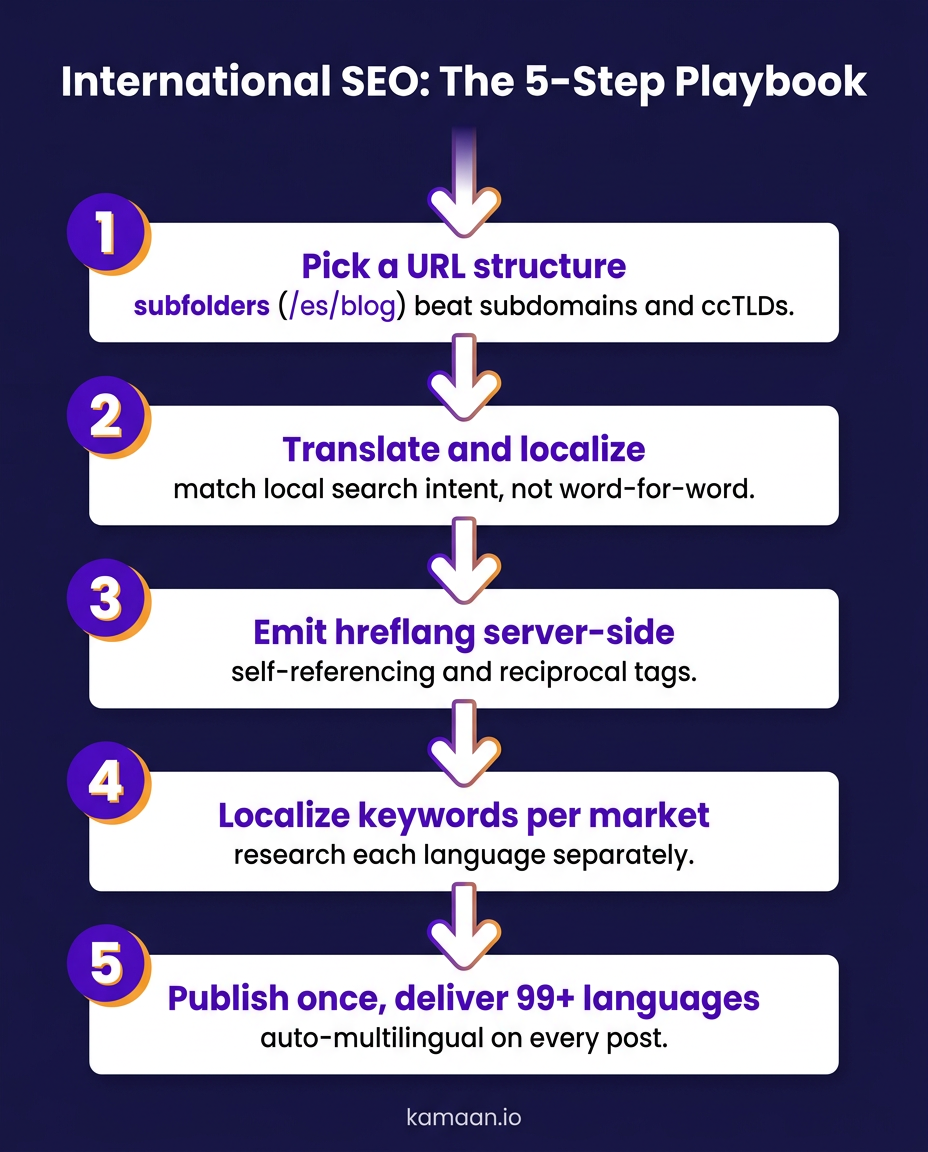
Step 1: Pick your URL structure and lock it. Choose subfolders unless you have a specific reason not to. Decide language-only versus language-plus-country now. Changing this later means redirects and lost authority, so commit up front. See our deeper breakdown in blog URL structure for multiple languages.
Step 2: Localize keywords, then content. For each target market, run keyword research in that language before you translate. Find the phrase locals actually use, then write or adapt the content around it. This is the step that separates pages that rank from pages that merely exist.
Step 3: Emit hreflang correctly. Every page variant needs a self-referencing hreflang tag plus a tag for each sibling language, and an x-default fallback. These have to be reciprocal across the whole set. Our hreflang tags guide covers the exact syntax and the mistakes to avoid.
Step 4: Keep canonicals consistent. Each language version canonicalizes to itself, not to the English original. Hreflang and canonical must agree, or crawlers get contradictory signals.
Step 5: Publish, then monitor. Submit updated sitemaps, run a site crawler's hreflang audit to catch missing return tags (Search Console retired its International Targeting report in 2022), use URL Inspection to confirm the Google-selected canonical on each language version, and filter the Performance report by country to track rankings per market to see which languages earn traffic and which need better localization.
For the fuller version of this workflow, our multilingual SEO guide walks through each pillar with more examples.
How Kamaan handles the parts teams get wrong
Two of the five steps above, hreflang emission and multi-language publishing, are where teams lose the most time and make the most mistakes. Those are exactly the parts Kamaan is built to handle for you.
Kamaan is a headless blog CMS. Its Auto-Multilingual Delivery takes one article and delivers it in the languages your plan covers, up to 99+ on the Unlimited tier, and it emits the hreflang tags server-side, correctly reciprocal, so your dev team never hand-maintains them. You get the subfolder pattern (/es/blog, /de/blog) as the default, which is the structure this playbook recommends. That collapses steps 1, 3, and much of 5 into a setting rather than a project.
It is also a command center: if you run more than one product blog, you manage every one of them, in every language, from a single dashboard and a single bill, instead of standing up international SEO separately for each site. And because Kamaan ships an MCP Server and ChatGPT Actions, you can plan, translate, and publish a market-ready post from inside Claude or ChatGPT without opening a dashboard at all.
Real-world scenarios
A solo founder runs one SaaS blog in English and wants German and Spanish traffic. On Kamaan's Growth plan (3 sites, 3 languages), they publish an English post once. Kamaan delivers the German and Spanish versions at /de/blog/ and /es/blog/, emits reciprocal hreflang server-side, and the founder never touches a <link rel="alternate"> tag. Their translated pages get indexed as distinct, correctly targeted variants instead of duplicate-content noise.
An agency managing blogs for ten SaaS clients used to configure hreflang and URL structure client by client. On Kamaan's Scale plan (10 sites, 10 languages), they run all ten blogs from one dashboard. When a client asks to add a new language market, it is a toggle, not a two-week technical project. One account, one invoice, ten internationalized blogs.
FAQ
What is international SEO?
International SEO is the process of optimizing a website so search engines understand which countries and languages each version of your content targets, then serve the right version to each user. It rests on three pillars: URL structure, hreflang annotations, and localized content.
Is international SEO the same as translating my blog?
No. Translation is one input, but international SEO also requires the correct URL structure, reciprocal hreflang tags, consistent canonicals, and localized keyword research. A perfectly translated page with broken hreflang or the wrong target keyword will not rank.
Should I use subfolders, subdomains, or country domains?
For most blogs, subfolders (example.com/de/blog) are best because they keep all ranking authority on one domain. Subdomains and country domains (ccTLDs) suit large organizations with separate regional teams or legal entities, and they cost more to build and maintain.
What is hreflang and do I really need it?
Hreflang is an HTML annotation that tells search engines which language and region a page targets. If you publish the same content in multiple languages, you need it, otherwise Google may serve the wrong version or treat your variants as duplicates. SEMrush has reported that over 75% of sites using hreflang have errors in it, so correctness matters as much as presence.
How many languages should I start with?
Start with the two or three markets where you already see demand or have product traction, rather than translating into everything at once. Prove that international SEO drives traffic in a few languages, then expand. A CMS that supports publish-once delivery makes adding languages cheap enough that you can scale when the data justifies it.
Does auto-translated content hurt SEO?
Auto-translation itself is not penalized, but shipping unreviewed machine output that reads unnaturally can hurt trust and engagement. The practical approach is to automate the mechanical parts (delivery, hreflang, URL structure) and keep a light human review on the actual wording for each market.
How long does international SEO take to show results?
Expect a few months for translated pages to index and start ranking, similar to any new content. Correct hreflang and URL structure speed up how quickly search engines understand and correctly attribute each version, which shortens the ramp compared to a broken setup.
Is international SEO still worth it in 2026 with AI search?
Yes, arguably more so. As AI Overviews and answer engines expand into multiple languages, the same fundamentals decide which version they surface: URL structure, correct hreflang, and localized content. Getting these right makes your pages eligible to be the source an AI cites in a given market, so the technical groundwork matters more, not less.
Related on Kamaan
- How to Build a Multilingual Blog. The complete guide this playbook sits under, covering strategy through delivery.
- Multilingual SEO. A deeper look at the three technical pillars and how to keep them consistent.
- Hreflang Tags Explained. Exact syntax, x-default, and the reciprocity rules that most sites get wrong.
- Blog URL Structure for Multiple Languages. Subfolders vs. subdomains vs. query params, with the tradeoffs.
- Auto-Translate Blog Posts. What machine translation gets right, what it breaks, and how to combine it with review.
Start building with Kamaan
Turn one blog into organic traffic from every market you care about.
Kamaan gives you one dashboard for all your product blogs, auto-translated into every language your plan covers on each publish (up to 99+ on the Unlimited tier), with hreflang emitted correctly server-side so international SEO stops being your dev team's backlog. First month free.