Search "jamstack" and you get the official site telling you it "decouples the web experience layer from data and business logic," a Cloudflare page full of acronyms, and a six-year-old Reddit thread arguing about whether it is dead. None of that helps a founder trying to decide how to build a blog. So here is the plain version: Jamstack is a way of building websites that are fast and hard to break, by shipping prebuilt pages instead of generating them on every visit. This guide explains what the word means, whether it still matters in 2026, and when it is the right call for your blog, without the jargon.
Quick takeaways
- Jamstack stands for JavaScript, APIs, and Markup. It is an architecture, not a product you buy.
- The core idea: build your pages ahead of time into static files, serve them from a fast global network, and pull in dynamic data through APIs when needed.
- The payoff is speed, security, and low hosting cost. A prebuilt page has no database to query and little to hack.
- The term has fallen out of fashion since about 2023, but the pattern it describes (static generation plus APIs plus a headless CMS) is now just how modern sites are built.
- For a blog, Jamstack plus a headless CMS is close to ideal: content updates rarely, so prebuilt pages are fast and fully indexable.
What Jamstack actually means
Jamstack is an approach to building websites where the pages are prepared in advance and served as plain files, rather than assembled fresh by a server on every request.
The name is an acronym coined by Netlify's Mathias Biilmann in 2015:
- J is for JavaScript, which handles any interactive behavior in the browser.
- A is for APIs, which supply dynamic data (comments, search, a store) over HTTP.
- M is for Markup, the prebuilt HTML that gets served to the visitor.
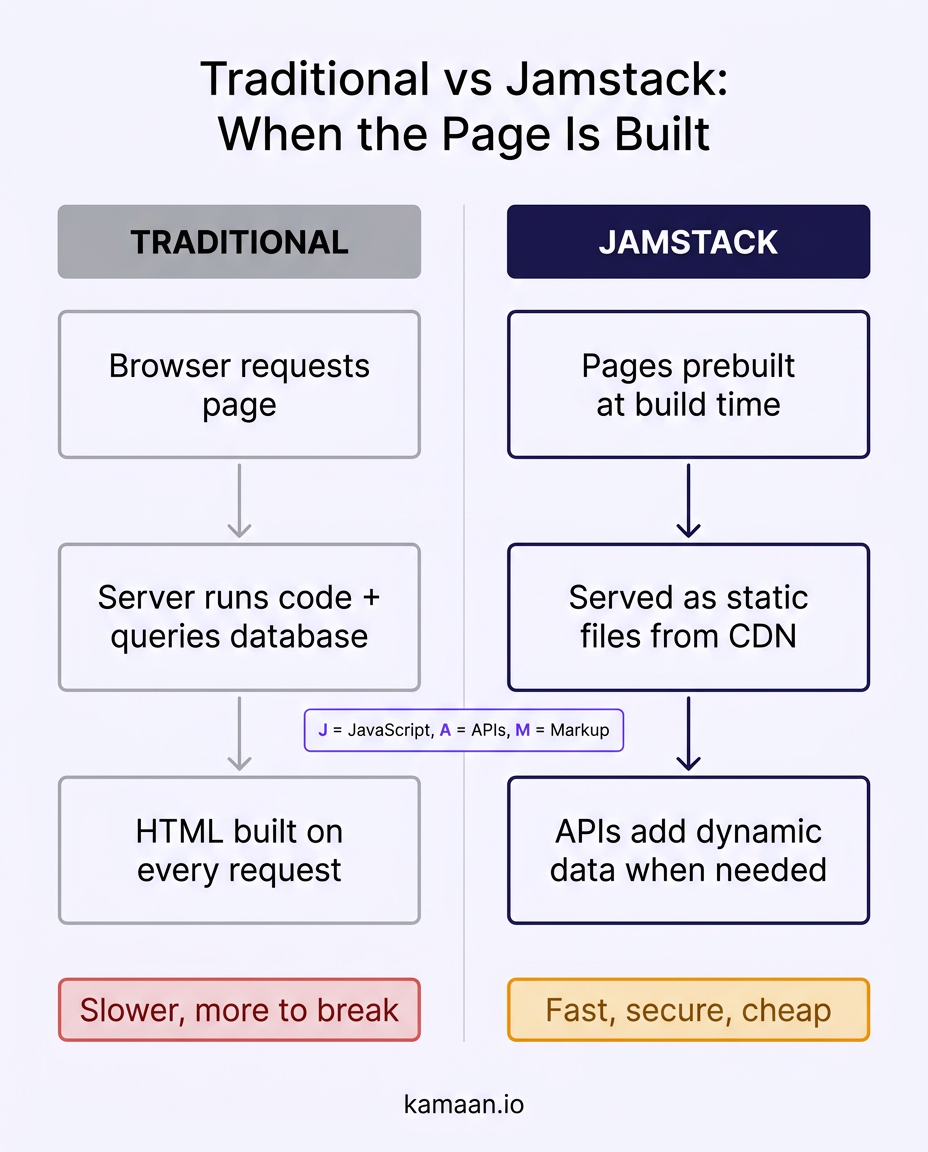
The important word is "prebuilt." In a traditional setup, a server runs code and queries a database every time someone loads a page, then builds the HTML on the spot. In a Jamstack setup, that HTML is generated once, ahead of time, and stored as a static file on a content delivery network. When a visitor arrives, they get the finished file instantly, with no server work in between.
That single shift, doing the work up front instead of on every request, is the whole idea. Everything else is a consequence of it. If you want the closely related concept that supplies the content for those prebuilt pages, the plain-English guide to what a headless CMS is is the companion to this one.
Why founders should care
You do not need to love architecture diagrams to benefit from Jamstack. Three concrete outcomes matter to anyone running a product blog.
Speed. A prebuilt page served from a nearby CDN edge loads almost instantly. There is no database to query and no server to render, so time-to-first-byte is tiny. Speed is a ranking factor and a conversion factor, so this is not just an engineering nicety.
Security. There is very little to attack. No live database sits behind each page view, and no server-side code runs on request, so the classic ways sites get breached mostly do not apply. A static file is a hard target.
Cost and reliability. Serving static files is cheap and scales trivially. A traffic spike that would melt a database-backed site is a non-event for a CDN handing out files. Hosting a Jamstack blog often costs close to nothing.
Prebuilt pages are fast, cheap, and hard to break, and for a blog those three properties line up almost perfectly with what you need.
The comparison below shows the core difference: when the page actually gets built.
Is Jamstack still relevant in 2026?
This is the honest question, and it deserves an honest answer: the word has faded, the pattern has won.
Around 2023 the term "Jamstack" started falling out of fashion. Netlify broadened its definition, the marketing lost its edge, and plenty of developers declared it dead. But look at how modern sites are actually built now, and the Jamstack pattern is everywhere: a static-generating framework (Next.js, Astro, Nuxt) pulling content from a headless CMS through an API and deploying prebuilt pages to a global edge network. That is Jamstack. It simply became the default, so people stopped naming it.
So if you read that "Jamstack is dead," translate it as "the label is out of fashion." The architecture, prebuilt markup plus APIs plus a headless CMS, is more common than ever. For a founder, the takeaway is practical: do not get hung up on the term. Care about whether prebuilt static pages fed by an API are right for your blog. For most blogs, they are.
When Jamstack is the right choice for a blog
A blog is close to the perfect Jamstack use case, for one reason: blog content changes rarely. An article, once published, mostly sits still. That means you can build it into a static file once and serve that file thousands of times without regenerating it. You get all the speed and none of the downside.
Jamstack fits your blog well when:
- Content updates on the scale of hours or days, not seconds. Blogs qualify.
- You care about page speed and Core Web Vitals, which you should for SEO.
- You want low, predictable hosting costs.
- You already use, or are happy to use, a framework like Next.js, Astro, or Nuxt.
It fits less well when a page must reflect data that changes by the second (a live dashboard, a stock ticker), though even then modern frameworks blend static and dynamic rendering per page. For a content blog, that caveat rarely bites. The benefits of a headless CMS cover the tradeoffs in more depth.
"Jamstack is dead" almost always means the label is unfashionable, not that the architecture stopped working. Prebuilt pages fed by APIs are now just how good sites are built.
How the pieces fit together for a blog
Here is the concrete shape of a Jamstack blog, end to end.
Your content lives in a headless CMS, separate from your site. Your framework (say Astro or Next.js) fetches that content through an API at build time and generates a static HTML page for each article. Those pages deploy to a CDN. When a reader or a crawler requests a URL, the CDN hands back the finished HTML immediately. If you need something dynamic, like a comment count, JavaScript calls an API in the browser after the page loads.
The headless CMS is the part that supplies the "M." Without a clean content source, your framework has nothing to prebuild. That is why Jamstack and headless CMS are talked about together: they are two halves of the same setup. The Next.js integration guide and the Astro static blog guide show the fetch-and-build step for two of the most popular Jamstack frameworks. If WordPress is your content source, headless WordPress with Next.js covers that pairing. If Sanity is the content source you are weighing, what Sanity costs and what to use instead sets it against lighter options for a blog.
Choosing which headless CMS sits at the front of that chain is the decision with the longest tail, since your framework and hosting are far easier to swap later. SaaS CMS options ranked for product teams walks through the shortlist.
Where Kamaan fits in a Jamstack setup
In a Jamstack blog, the headless CMS is the content source your framework builds from. That is exactly the role Kamaan plays.
Kamaan delivers your articles as standard JSON over its REST API Delivery, so a Jamstack framework can fetch them at build time and generate static pages. It is framework-agnostic: Next.js, Nuxt, SvelteKit, Astro, React, or Vue all consume the same clean API, and the Developer Setup Documentation covers wiring each one. The CMS supplies the content and the SEO fields; your framework owns the prebuilt markup and the deploy.
Three things make it a comfortable fit for a founder rather than just a developer. Auto-Multilingual Delivery means publishing an article also delivers it in every language on your plan, up to 99+, each at its own URL with correct hreflang emitted server-side, so a multilingual Jamstack blog does not become a manual chore. If you run more than one product, Multi-Site Management lets you feed several Jamstack blogs from one account and one dashboard, up to 30 sites on the top tier, instead of standing up a separate CMS per project. And because you will trigger publishes and rebuilds constantly, Kamaan is AI-native: the Kamaan MCP Server connects Claude or Cursor to your account, and ChatGPT Actions does the same from ChatGPT, so you can draft, edit, and publish the content your Jamstack build consumes without leaving the AI tool you already work in.
FAQ
What does Jamstack stand for?
JavaScript, APIs, and Markup. JavaScript handles browser interactivity, APIs supply dynamic data over HTTP, and Markup is the prebuilt HTML that gets served. The term was coined by Netlify's Mathias Biilmann in 2015.
Is Jamstack a framework or a product?
Neither. It is an architectural pattern, a way of structuring a site. You implement it with tools like static-site frameworks (Next.js, Astro, Nuxt), a headless CMS, and a CDN. You cannot "install Jamstack"; you build in the Jamstack style.
What is the difference between Jamstack and full-stack?
A traditional full-stack app renders HTML on the server on every request, usually querying a database each time. Jamstack prebuilds the HTML ahead of time and serves it as static files, pulling dynamic data through APIs only when needed. The main difference is when the page is built: on request versus in advance.
Is Jamstack dead in 2026?
The term has fallen out of fashion, but the pattern it describes is more common than ever. Modern sites routinely combine a static-generating framework, a headless CMS, and CDN deployment, which is Jamstack by any other name. Treat "dead" as a comment on the buzzword, not the architecture.
Do I need to be a developer to use Jamstack?
To build the site, yes, you or a developer wires up the framework and deploy. But writing and publishing content sits in the headless CMS, which non-developers use comfortably. The split is intentional: developers own the build, writers own the content.
What is a static site generator?
A tool that takes your content and templates and produces plain HTML files ahead of time. Next.js, Astro, Nuxt, and Gatsby can all generate static sites. The output is the prebuilt "Markup" in Jamstack.
Why is Jamstack good for SEO?
Prebuilt pages are fast, and speed helps rankings. More importantly, static HTML is fully present in the raw response, so search engines and AI crawlers can read your content without waiting on client-side JavaScript. That combination of speed and crawlable HTML is strong for SEO.
Does Jamstack work with a headless CMS?
Yes, and the two are usually paired. The headless CMS supplies the content (the Markup source) through an API, and the framework prebuilds pages from it. A headless CMS is effectively the content layer of a Jamstack blog.
How fast is a Jamstack site compared to WordPress?
A prebuilt page served from a CDN typically responds far faster than a database-backed WordPress page rendered on request, because there is no server work between the request and the response. Real numbers depend on setup, but the architecture removes the slowest steps.
Is Jamstack cheaper to host?
Usually much cheaper. Serving static files from a CDN costs little and scales without extra infrastructure. There is no always-on database or application server to pay for and maintain, which is a big part of Jamstack's appeal for small teams.
Can a Jamstack blog handle multiple languages?
Yes. You generate a prebuilt page per language and per article, and emit hreflang so search engines treat them as one international set. Doing that by hand is tedious, which is why a headless CMS that delivers translations and hreflang for you is a natural fit.
Related on Kamaan
- What is a headless CMS: a plain-English guide for SaaS teams
- Headless CMS benefits: what you actually get and what you give up
- Headless CMS Next.js integration: step-by-step setup from zero to live blog
- Headless CMS for Astro: static blog setup with a REST API CMS
Start building with Kamaan
Kamaan is the headless blog CMS for a Jamstack setup: clean JSON over a REST API for any framework, auto-translated into 99+ languages with server-side hreflang on every publish, and one dashboard for every product blog you run. First month free. Start free at kamaan.io