You picked Sanity because it kept showing up in headless CMS lists. Then you sat down to ship a blog and ended up writing TypeScript schema files, learning Sanity Studio, and debugging GROQ queries before you had published a single article. For a structured-content team building a multi-surface platform, that effort pays back. For a SaaS founder who just wants a blog, it is a tax.
Kamaan is the command center for multi-product founders and agencies who run many SaaS blogs: manage every blog from one dashboard, and run every operation across all of them from Claude, ChatGPT, Cursor, or any MCP client. Sanity is a structured-content platform that treats your blog as one of many possible content types. This article does the honest comparison: where Sanity is the right call, where Kamaan is, and what each one costs you in setup time and monthly bills.
Quick takeaways
- Sanity requires schema-as-code in TypeScript or JavaScript. Kamaan ships the blog data model out of the box.
- Sanity's free tier covers a single dev seat. The first paid tier (Growth) is $99 a month per dataset. Kamaan Starter covers one site; first month free.
- Auto-translate and hreflang on Kamaan Growth and up are built in. Sanity treats translation as a plugin or a custom workflow.
- Kamaan ships an MCP Server and ChatGPT Actions natively. Sanity does not.
- Pick Sanity when you need flexible content modeling for many surfaces (web, mobile, in-app). Pick Kamaan when the deliverable is one or more blogs that need to ship in many languages.
What Sanity is actually for
Sanity is a structured-content backend. You define schema in code (TypeScript or JavaScript), and that schema becomes the studio UI, the API responses, and the GROQ query surface in one motion. The flexibility is the product: you can model an article, a podcast episode, a course, a marketing block, a product page, and the SDK will let you query them all in one go.
That model serves teams that have content living on multiple surfaces. A media company publishing the same story to a website, an app, and a partner feed gets real leverage from Sanity. A marketing team assembling landing pages from reusable blocks gets real leverage from Sanity. A founder who needs a blog gets the same machinery, the same setup cost, and a fraction of the value.
What you actually pay for that flexibility
You pay in two currencies: setup time and dataset count.
Setup time first. Before you publish article one, you write a schema for article (title, slug, body, author, categories, hero image, SEO fields), a schema for author, a schema for category, and a portable-text configuration for the body. You configure Sanity Studio. You configure CORS for your frontend. You write the GROQ queries that fetch articles. You set up image CDN transforms. For a developer who has done it before, it is a half-day. For a founder writing the schema for the first time, it is a real chunk of a workweek.
Dataset count next. Sanity bills per dataset and dataset bandwidth. The free tier covers one project with limited bandwidth and a few dev seats. The Growth tier (the first paid tier, $99 a month per project per Sanity's pricing page) raises caps and unlocks roles. If you run three SaaS products and want each blog on its own dataset, that is three Growth tiers, $297 a month, before you add a translation workflow.
What Kamaan is built for
Kamaan is a headless blog CMS. The data model is already shaped for blog content: articles with rich text, scheduled publishing, categories, authors, SEO metadata, and multilingual versions. You do not model it. You write, you publish, you get a REST endpoint and a multilingual delivery.
The product makes two operating bets specifically. The first is that founders running more than one SaaS want one account, one dashboard, and one bill that covers all their blogs. Kamaan tiers cover multiple sites: Starter (1 site), Growth (3 sites), Scale (10 sites), Unlimited (up to 25 sites). The second bet is that AI tools (Claude, ChatGPT, Cursor) are where founders actually write blog content in 2026, so the CMS exposes a MCP Server and ChatGPT Actions natively.
Sanity vs Kamaan on ten dimensions
The chart below puts the two side by side on the dimensions that actually matter for a SaaS blog.
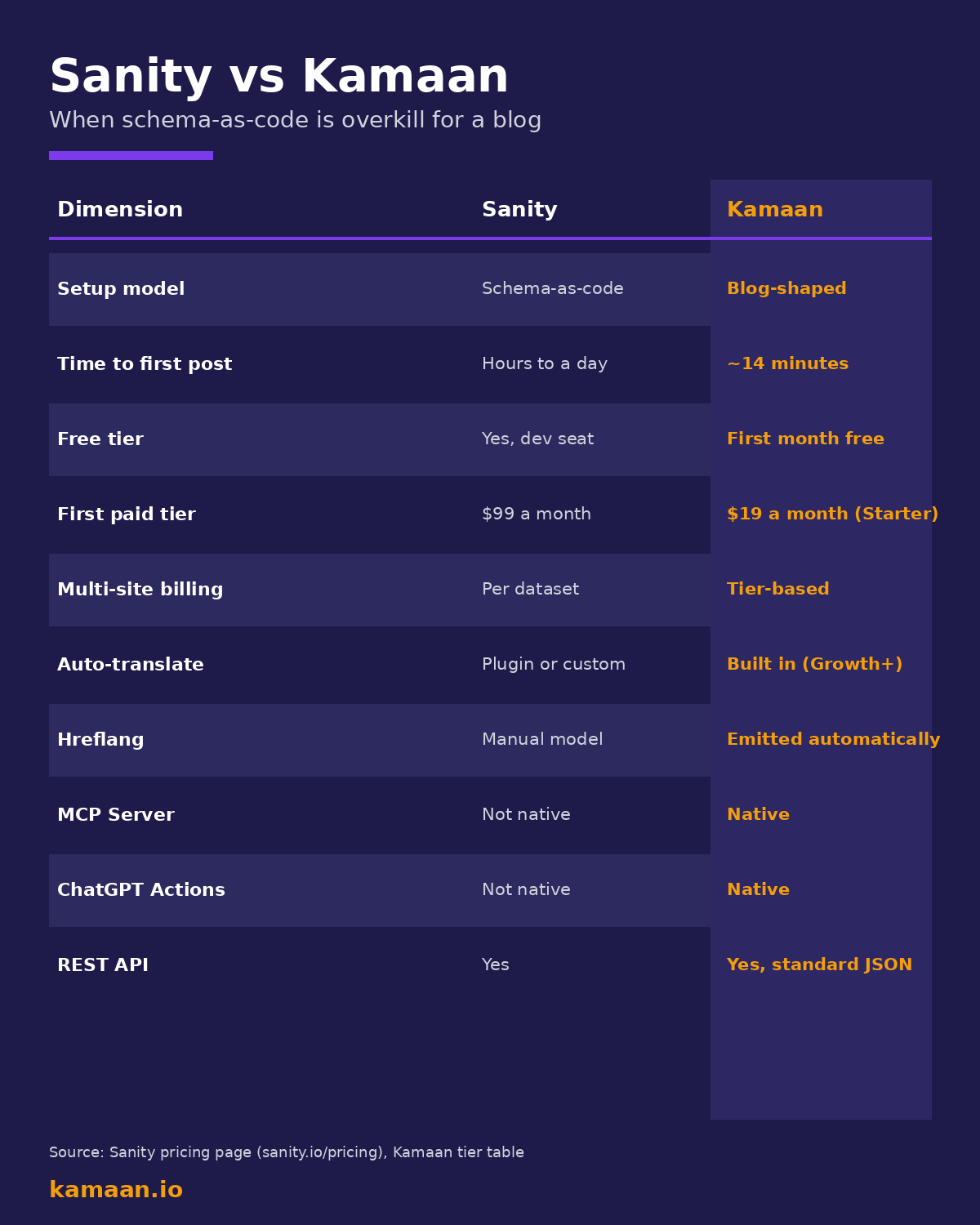
Three rows are worth flagging.
The first paid tier line. Sanity Growth at $99 covers one project. Kamaan Starter covers one site. If your only deliverable is a blog, that gap is real money over a year, and it widens when you add products.
The auto-translate line. Kamaan's Auto-Multilingual Delivery is included on Growth, Scale, and Unlimited; publish once in English and the Spanish, German, French, and Italian versions are delivered automatically at the right URLs with correct hreflang. Sanity does not ship translation. You add a plugin (Sanity has community translation plugins) or you wire a custom workflow against DeepL or Google Translate. That works, but it is a second product to learn and a second bill.
The MCP Server / ChatGPT Actions lines. Kamaan ships both natively on every tier. Sanity has no native MCP server or ChatGPT Actions schema for content management. You can build one, but it is a custom integration.
When Sanity is still the right call
If your team is building content that lives on more than just a blog (mobile app, partner feed, marketing landing pages, a documentation site, a product catalog), Sanity's modeling flexibility is a feature, not overhead. If you have a developer who already knows GROQ and portable text and wants to invest in a long-running content backbone, Sanity is a strong choice. If you need real-time collaborative editing in a studio UI that you can customize per-team, that is Sanity's lane.
If your deliverable is a SaaS blog, none of that flexibility is doing work for you, and the setup cost is going on your runway.
Real-world workflow scenarios
A solo founder running a single B2B analytics tool picks Kamaan Starter for one site and one language. She writes her launch announcement in a Claude conversation through the MCP Server. Kamaan publishes the English article in under 15 minutes from sign-up to live URL, with SEO metadata, OG fields, and a featured image set. No schema, no GROQ, no studio to configure. The Sanity equivalent for the same outcome would have been a free-tier project plus a day of schema and frontend wiring.
A multi-product founder running three SaaS products picks Kamaan Growth, which covers three sites. She writes one launch article for the new invoicing release through ChatGPT Actions. Kamaan publishes the English article and at the same publish delivers Spanish, German, and French versions at their own URLs with correct hreflang. Total cost across all three products: one Growth plan; first month free. The Sanity equivalent would have been three Growth projects at $99 a month each ($297 total), each with its own schema, plus a translation workflow plugged in or built.
What you give up by picking Kamaan
Be honest about the trade-off. Kamaan does not let you model arbitrary content types. There is no portable text editor with custom annotations. There is no GROQ query language. If a marketer asks for a new "case study" content type with custom fields next quarter, Kamaan is not the place to add it. The data model is blog-shaped on purpose, and that constraint is the product.
For a SaaS founder whose deliverable is a blog and possibly a documentation site, that constraint is the point. For a team building a content platform with five surfaces, that constraint is a wall. Pick the tool that matches the shape of what you are building.
FAQ
What is the cheapest paid Sanity plan?
Sanity Growth is the first paid tier at $99 a month per project, per sanity.io/pricing. The free tier exists with limited dev seats, bandwidth, and API quota; once you cross those limits or add real teammates, you move to Growth. Kamaan Starter is the entry point for a single-site blog with the first month free.
Does Kamaan support custom content types?
No. Kamaan ships a blog data model: articles with rich text, scheduling, categories, authors, SEO metadata, and multilingual versions. You cannot define a new content type. If you need that, Sanity (or Contentful) is the right tool. For a SaaS blog, the constraint is the feature.
How long does it take to launch a blog on Kamaan vs Sanity?
Kamaan's homepage benchmark is about 14 minutes from sign-up to a published English article, with the developer setup for first-time Next.js wiring taking 40 to 60 minutes. Sanity is hours to a day for a first-time schema build, plus the studio and frontend setup. The gap is real, and it is most of why founders pick Kamaan for a blog-only deliverable.
Can I migrate from Sanity to Kamaan?
Yes. Sanity's CLI exports your dataset to JSON. Kamaan's REST API accepts article creates with all the standard fields. A small import script maps Sanity's portable text to Markdown (the body shape Kamaan expects) and uploads the articles. Translations carry over if you have language metadata on your Sanity documents; otherwise they regenerate on publish via Auto-Multilingual Delivery.
Does Sanity have an MCP server or ChatGPT integration?
Not as a first-party shipped feature. Sanity has APIs you can build against, and community projects exist. Kamaan ships a first-party MCP Server and ChatGPT Actions schema, reachable from every tier including Starter. If AI-native publishing is a real workflow for you, that is a meaningful gap.
Is GROQ better than REST for a blog?
GROQ is more expressive when your content has graph-like relationships across many types. For a blog, the queries you actually run are "list articles by date" and "fetch one article by slug." A REST API with standard JSON is enough, and it works from every framework without a query-language SDK. Kamaan's REST shape is straightforward; Sanity's GROQ is more powerful and more learning curve.
Does Kamaan have a free tier?
Kamaan does not have a permanent free tier. Every tier (Starter, Growth, Scale, Unlimited) includes the first month free, which is long enough to ship real articles, test the AI integrations, and verify the multilingual delivery against your actual stack before paying.
What about content collaboration features?
Sanity's studio supports real-time collaboration with multiple editors and roles. Kamaan supports multiple team members on Growth (3), Scale (10), and Unlimited (unlimited), with role-based access and shared editing. For a small SaaS team, the Kamaan flow is enough. For a 15-person content team with formal review queues, Sanity is the better fit.
Related on Kamaan
- Best Headless CMS for Startups. The honest comparison hub for headless CMS choices.
- Contentful Alternatives: 6 Tools That Are Not $300 Per Month. The broader cluster of alternatives, including Sanity, Storyblok, Ghost, Strapi, and ButterCMS.
- Contentful vs Kamaan. The other big enterprise-vs-Kamaan comparison.
- What Is a Headless CMS. Category context if you are still deciding whether headless is the right shape.
- Auto-Translate Blog Posts. Why bolting a translation plugin onto Sanity tends to break at scale.
Start building with Kamaan
A blog CMS that does not require schema files
Kamaan gives you a headless blog CMS designed for SaaS founders, with auto-translation, MCP, and ChatGPT Actions. Starter covers one site and one language; first month free. The Growth tier covers three sites and three languages when you are ready.